TrendThread Journal
ISRO NVS-03 Launch Today: India's NavIC Comeback and What L1 Means for Your Phone
The ISRO NVS-03 launch is India's navigation comeback story: a 2,250 kg second-generation NavIC satellite, an indigenous atomic clock, and a new L1 signal built for the phones, cars and wearables you actually use.
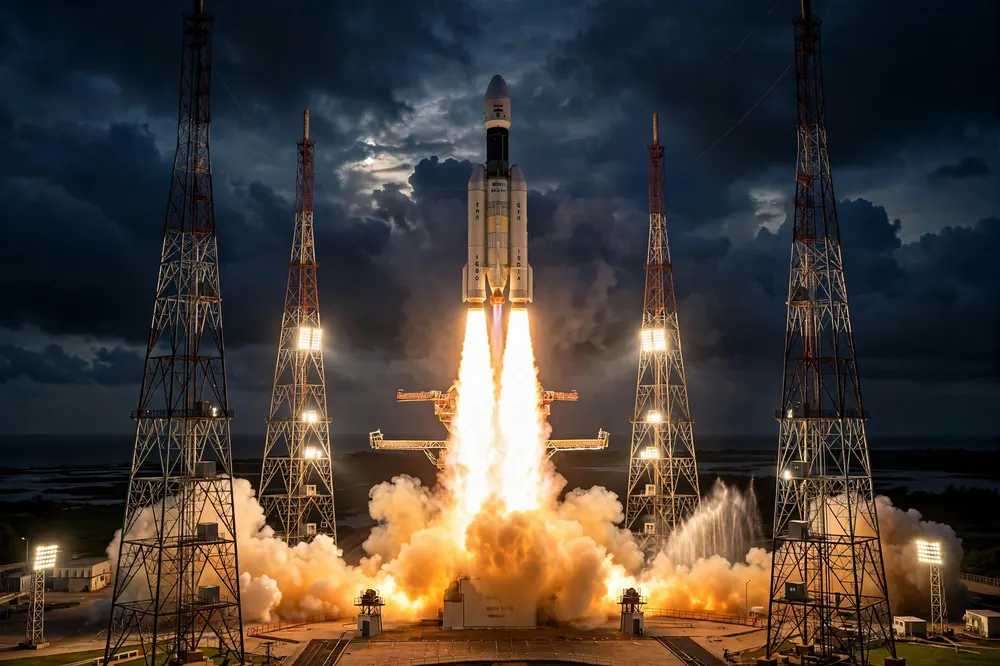
Picture this: it is late on a Friday night in India, a rocket is standing floodlit on the coast at Sriharikota, and the whole point of the mission is something you will never see — a timing signal, beamed down from orbit, that helps your phone figure out exactly where you are. That is the ISRO NVS-03 launch in one sentence, and it is a bigger deal than it sounds. The ISRO NVS-03 launch, aboard the GSLV-F18 rocket from the Satish Dhawan Space Centre, is scheduled for 11:21 a.m. PDT on Friday, October 30, 2026 — 11:51 p.m. IST in India — and it is India's attempt to rebuild something most of us take for granted: a navigation system of its own.
What Is NVS-03, and Why Does India Need Its Own GPS?
NavIC — Navigation with Indian Constellation, formerly called IRNSS — is India's independent regional navigation system, its answer to America's GPS, Russia's GLONASS, Europe's Galileo and China's BeiDou. It provides position, velocity and timing services across India and a region extending about 1,500 km around the country's borders. That matters for more than maps: navigation timing underpins banking networks, power grids, transport, disaster response and the military, and relying entirely on somebody else's system for it is a strategic vulnerability no large country wants.
NVS-03 is the third satellite in NavIC's second-generation series, following NVS-01 and NVS-02. It weighs about 2,250 kg and will be placed into a Geosynchronous Transfer Orbit (GTO) roughly 18 minutes and 40 seconds after liftoff, from where it will be raised to its final orbit. The GSLV-F18 flight is the 20th flight of India's Geosynchronous Satellite Launch Vehicle, a roughly 50-metre, 420-tonne three-stage rocket. The planned transfer orbit has a perigee of about 170 km and an apogee of about 37,023 km, at an inclination of 20.75 degrees.
Here is the honest context: NavIC has had a rough few years. Several first-generation satellites aged out or failed, and the constellation shrank below the strength it needs for reliable, continuous service. Restoring NavIC to minimum operational capacity will take more than one launch — ISRO still needs NVS-04 and NVS-05 after NVS-03, alongside the existing NVS-01. So this launch is not a finish line. It is the comeback's first real step, and that is exactly why it is worth watching.
The NVS-02 Failure: What Went Wrong in January 2025
The comeback framing is not marketing. It is literal. NVS-02, launched in January 2025, never reached its intended orbit because its orbit-raising engine could not fire. The investigation traced the fault to the satellite's pyro valves — tiny one-time switches that open with a small explosive charge when they receive an electrical signal, letting fuel and oxidiser flow to the main Liquid Apogee Motor and the steering thrusters. Those valves never received the signal: a disengaged contact in a connector on the oxidiser line cut off both the main and backup paths at once. The satellite was left drifting in an orbit it was never meant to keep.
That failure is why NVS-03 carries an unusual engineering change, cleared during the Mission Readiness Review: this time, ISRO is flying the satellite with its pyrotechnic valves already open on the ground before liftoff, so propellant is ready the moment the engines need it — like leaving a tap open rather than trusting a remote switch later. Space Minister Dr Jitendra Singh has said the NVS-02 faults were corrected and the fix was successfully tested on CMS-03 (GSAT-7R), the 4,410 kg communication satellite lofted by LVM3 on November 2, 2025. Hot take: most space coverage treats a failed satellite as a footnote. It is not. For a navigation constellation, one stranded satellite is a hole in the sky, and NVS-03 exists to start filling it.
What L1 Means for Your Phone, Car and Watch
The headline upgrade on NVS-03 is the L1 signal. Existing NavIC satellites broadcast in the L5 and S bands; NVS-03 adds L1 alongside them. Why should you care about a letter and a number? Because L1 is the frequency that everyday consumer devices already speak. GPS, Galileo and BeiDou all use L1, which means phone, car and wearable chipmakers already build L1 receivers into mass-market hardware. A NavIC signal on L1 is a signal your next phone can actually hear without exotic, expensive hardware.
In practice, L1 should mean faster locks and better accuracy in cities where signals bounce off buildings, and more devices able to use NavIC at all — from budget phones to fitness watches to car dashboards.

The Indigenous Atomic Clock: A Tiny Machine That Runs a Continent
Every navigation satellite is, at heart, a flying clock. Your receiver works out its position by measuring tiny differences in the arrival times of signals from several satellites, so if the clocks drift, the positions drift. NVS-03 carries an indigenous rubidium atomic clock developed by ISRO's Space Applications Centre, alongside procured atomic clocks — the third locally developed atomic clock placed in orbit in this series, after NVS-01 and NVS-02.
Everyone says the rocket is the hard part of a space programme. They are wrong — the clock is. Building an atomic clock that survives launch vibration, radiation and years of temperature swings, and keeps time to billionths of a second, is one of the hardest pieces of engineering in the whole system, and for years it was a capability India had to import. Each indigenous clock in orbit is a step toward time sovereignty: India setting its own time, on its own hardware, rather than borrowing somebody else's. For a navigation system, that is not a patriotic footnote. It is the foundation.
"A navigation satellite is a flying clock. If the clocks drift, the positions drift — and that is why an indigenous atomic clock is the real payload of this mission."TrendThread notes on the NVS-03 mission
GSLV-F18: The Rocket Doing the Lifting
GSLV-F18 is the workhorse here, and it deserves a paragraph of its own. The Geosynchronous Satellite Launch Vehicle stands about 50 metres tall and weighs about 420 tonnes at liftoff, with a solid-core S139 booster holding 139 tonnes of propellant, flanked by four liquid strap-ons, each with a Vikas engine. It will lift off from the Second Launch Pad at Satish Dhawan Space Centre (SDSC SHAR), Sriharikota, in Andhra Pradesh, with live coverage from 23:20 IST on ISRO's official stream.
The mission profile is brisk: liftoff, then a climb through the atmosphere, stage separations, and deployment of NVS-03 into its transfer orbit about 18 minutes and 40 seconds after launch. After that comes the slow, careful part — orbit-raising burns over days, using the very engine system that failed on NVS-02, to circularise the orbit at geosynchronous altitude, followed by payload checks and commissioning before NVS-03 enters service. That orbit-raising phase, not the launch itself, is the part engineers will be watching most closely. A clean liftoff is a great night. A clean orbit-raising is a working satellite.
| Mission fact | Detail | Why it matters |
|---|---|---|
| Launch | Oct 30, 2026 — 11:21 a.m. PDT / 11:51 p.m. IST | Live tonight; the comeback begins here |
| Rocket | GSLV-F18, 20th GSLV flight, ~50 m, ~420 tonnes | Proven workhorse for heavy GTO missions |
| Satellite | NVS-03, ~2,250 kg, 2nd-generation NavIC | Third NVS satellite; restores constellation depth |
| New signal | L1 added to existing L5 and S bands | Everyday phones, cars and wearables can tune in |
| Clock | Indigenous rubidium atomic clock + procured clocks | Time sovereignty; accurate positioning |
| Coverage | India + ~1,500 km around its borders | Regional system, built for its home region |
| Next steps | Orbit raising, then NVS-04 and NVS-05 | Full minimum capacity still needs two more launches |
- More devices can use NavIC: L1 is already built into mass-market phone and car chips.
- Faster, steadier locks: More satellites in view means quicker fixes in cities and indoors-adjacent spots.
- Better urban accuracy: Multi-constellation fixes cope better with signals bouncing off buildings.
- Real redundancy: NavIC plus GPS plus Galileo means no single system is a single point of failure.
- Wearables join in: Watches and trackers with L1 chips can add NavIC to their positioning mix.
How to Watch, and What Happens Next
ISRO's live coverage begins at 23:20 IST on October 30 (10:50 a.m. PDT), with liftoff at 23:51 IST (11:21 a.m. PDT) from Sriharikota's Second Launch Pad. If you are watching for the story rather than the spectacle, keep an eye on three milestones: a clean liftoff and stage sequence, deployment into transfer orbit at about T+18 minutes 40 seconds, and — over the following days — the orbit-raising burns that NVS-02 never got to make. Those burns are the real test of the pyro-valve fix.
Longer term, the story to follow is the constellation, not the single satellite. NVS-04 and NVS-05 are still to come, and only with them does NavIC return to the minimum strength it needs for continuous, reliable service. Chipmakers, meanwhile, will decide how quickly L1 NavIC shows up in the phones and wearables sold in India and the surrounding region. The launch tonight is the necessary first domino. For a system that quietly underpins maps, money and emergency response, that is worth staying up for — or, on the US West Coast, worth a coffee break at 11:21 in the morning.
What time is the ISRO NVS-03 launch? Liftoff is scheduled for 11:51 p.m. IST on October 30, 2026 — 11:21 a.m. PDT — from the Second Launch Pad at Satish Dhawan Space Centre, Sriharikota. Live coverage starts at 23:20 IST. See The Hindu's live coverage for updates through launch night.
What is NavIC, and how is it different from GPS? NavIC is India's regional navigation system, covering India and about 1,500 km around it, while GPS is a global US system. NavIC gives India an independent source of position and timing, and its new L1 signal lets everyday devices use it alongside GPS. Read The Economic Times explainer for the five things NVS-03 changes.
Why did NVS-02 fail? In January 2025, NVS-02's pyro valves never received the signal to open, so fuel could not reach its orbit-raising engine, and it stayed in the wrong orbit. Investigators traced it to a disengaged contact in a connector on the oxidiser line. NVS-03 flies with its pyro valves already open as a fix, as detailed in The Week's mission report.
Will NVS-03 make my phone's maps better? Not overnight. The satellite must reach its final orbit and enter service, and your phone needs L1 NavIC support in its chip and firmware. Over time, though, more satellites plus L1 support should mean faster locks and better accuracy — especially in cities. If you are shopping for gear in the meantime, browse GPS smartwatches, car GPS navigators and dual-frequency GPS phones to see what multi-constellation support looks like today.
The bottom line: the ISRO NVS-03 launch is a comeback with a purpose — a heavier, smarter satellite, a homegrown clock, and a signal your phone can finally hear. One launch does not restore a constellation, but it restarts one. And for the millions of devices that will one day quietly navigate by NavIC, tonight's 11:21 a.m. PDT liftoff is where that future starts. Explore the journal for more stories at the intersection of tech and everyday life.
Part of the TrendThread journal: more guides and trend stories