TrendThread Journal
Winter Outfits 2026: 25 Warm, Chic Looks to Copy Now
Winter outfits 2026 are finally warm and chic — the layering system, the coat worth your money, and 25 formulas for every kind of cold day.
Picture this: it is 28 degrees, the wind is doing its worst, and you have exactly eleven minutes to look like a person who has her life together. Most winter outfits fail at this exact moment — not because you own the wrong clothes, but because winter dressing is treated like a survival exercise instead of a styling opportunity. Winter outfits 2026 change that equation. This season is the first in years where warmth and style are not negotiating against each other: the coats are longer, the knits are chunkier, the boots are built for actual walking, and the color palette finally escaped the all-black-everything rut. This is the ultimate guide — every formula, every layering trick, every budget shortcut — so you never again stand in front of a closet full of coats and feel like you have nothing to wear.
Here is the honest truth nobody tells you about winter style: the women who look best in January are not the ones with the most clothes. They are the ones with a system. A great coat, a knit that actually fits, one pair of boots you can walk a mile in, and a scarf that does the talking. Everything else is decoration. Winter outfits 2026 reward that kind of thinking, because the season's best trends — statement outerwear, rich chocolate and burgundy tones, oversized scarves, knee-high boots — are all built around a few hero pieces worn on repeat. Buy the heroes, rotate the supporting cast, and suddenly getting dressed in the dark at 7 a.m. stops feeling like a punishment.
1. The layering system that actually keeps you warm
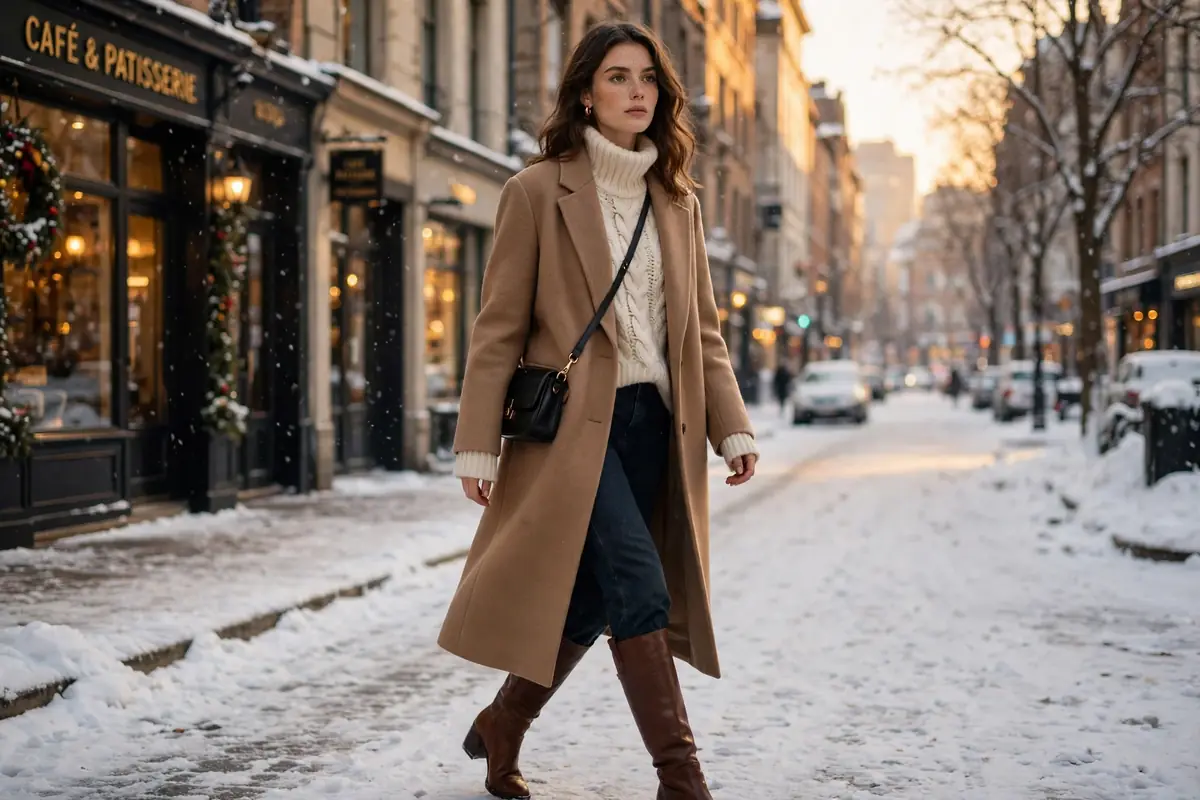
Everyone says "just layer" and then leaves you to figure out why you still feel cold and look like a marshmallow. Here is the system that works: a thin, warm base (merino or a heat-tech style thermal — not cotton, which holds sweat and chills you), a mid-layer with actual insulation (a chunky knit, a quilted vest, a fleece-lined shirt), and an outer layer that blocks wind. Three layers, each doing one job. The hot take? Most women wear their layers backwards: a heavy sweater under a thin coat, then wonder why they are freezing. Flip it. The coat is the insulation; the sweater is the style. A thin merino turtleneck under a proper wool coat will keep you warmer than a chunky knit under a fashion jacket, and you will look slimmer doing it.
The bulk problem has a fix too, and it is embarrassingly simple: vary the lengths. A hip-length knit under a knee-length coat, with a scarf breaking the line at the neck, creates a silhouette instead of a blob. Tuck the front of your knit into high-waisted trousers or a midi skirt and suddenly your waist exists again. And please, retire the idea that layering means adding volume everywhere — the 2026 rule is volume in one place only. Big coat, slim bottom. Chunky knit, streamlined coat. One statement, everything else quiet. That single rule will fix half the winter outfits you have ever hated in photos.
2. The coat is the outfit (so choose like it matters)
In winter, your coat is your outfit — it is what the world sees for four months, and it is photographed more than anything else you own. So here is my controversial opinion: spend your money on the coat and go cheap on almost everything underneath. A $300 wool coat over a $25 turtleneck looks expensive. A $60 coat over a $200 sweater looks like a $60 coat. Winter outfits 2026 are dominated by long wool coats in camel, chocolate, and burgundy; cocoon shapes for the slouchy set; belted wraps for the polished set; and faux fur for the main-character days. If you buy one coat this year, make it a knee-length wool wrap in a color you love — it works over jeans, over dresses, over office tailoring, and it makes a grocery run look like a magazine shoot.
Fit notes that matter: the shoulder seam should sit at your actual shoulder, not halfway down your arm (that is a different trend and it is not this one). The coat should close over your thickest sweater without pulling. And the sleeve should show about half an inch of your knit cuff — that little flash of texture is the difference between "wearing a coat" and "styling a coat." For petite frames, a coat that hits just above the knee keeps proportions intact; for tall frames, go full-length and enjoy the drama. And if you live somewhere with real snow, a hooded parka with faux-fur trim is not a style compromise anymore — the 2026 versions are genuinely chic, especially in deep green or oxblood.
3. Knitwear: the texture story of winter 2026
Winter outfits 2026 are a knitwear story first and everything else second. Cable knits, chunky roll necks, cropped jumpers layered over collared shirts, cowl necks that double as scarves — the runways and the streets agree that interesting knit texture is the easiest way to look intentional. The trick is choosing knits that hold their shape: look for a high wool or cashmere-blend content, ribbed cuffs that actually stay at your wrist, and a weight that drapes rather than clings. A knit that pills after two wears is not a bargain at any price; it is a donation to your lint roller.
Color-wise, winter 2026 knits go two directions and both are right. Direction one: rich and deep — chocolate brown, burgundy, plum, bottle green — the palette that makes winter skin glow and pairs beautifully with gold jewelry. Direction two: soft and light — cream, ivory, stone — the winter-white story that looks impossibly luxe against dark coats and dark denim. The myth to bust: "cream is impractical in winter." Cream knitwear is the fastest way to look expensive in January, and a good wool blend handles a coffee splash better than you think. Own one of each direction and your knit rotation is done.
4. The 25 outfit formulas: work, weekend, evening, and weather emergencies
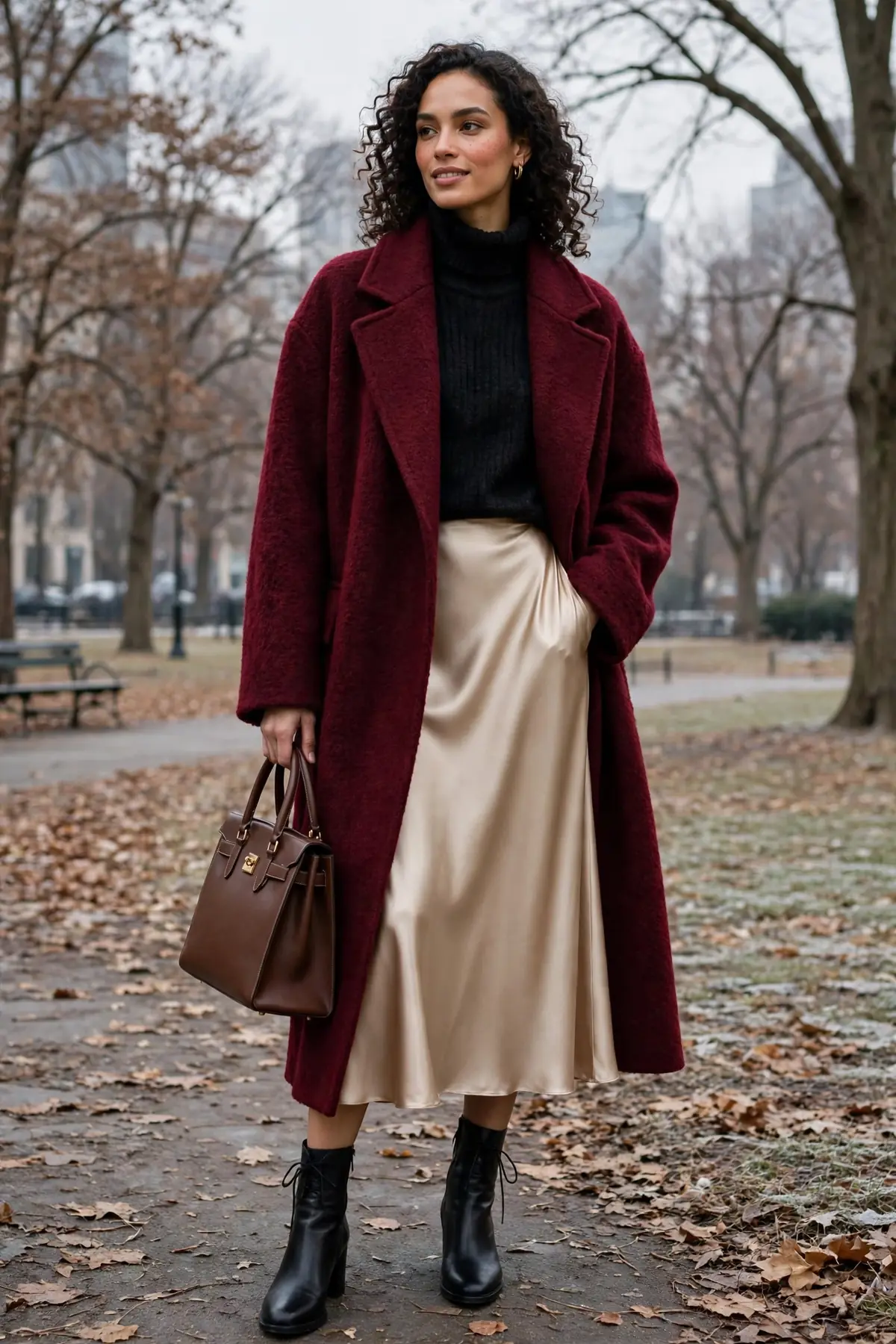
This is the section to screenshot. Twenty-five winter outfits 2026, organized by the life you actually live. For work: a camel coat over a cream turtleneck, charcoal wool trousers, and heeled ankle boots — add a burgundy bag and you are the best-dressed person in the meeting. For the coldest commute: thermal base, chunky knit, long puffer, fleece-lined jeans, snow boots, and a scarf wrapped twice — warmth first, and the scarf is your style statement. For a winter date night: a satin midi skirt, a fitted knit, knee-high boots, and a faux-fur coat — romantic without freezing, because the boots and the coat do the heavy lifting.
Weekend formulas deserve love too: wide-leg jeans, a cropped puffer, a striped knit, and chunky loafers with warm socks is the off-duty uniform of the season. For countryside walks: a shearling jacket, a roll-neck knit, straight-leg jeans, and sturdy lace-up boots — practical, and somehow always photogenic. For holiday parties: a velvet midi dress, heeled boots, a statement earring, and a long wool coat you actually want to be photographed in — because the coat check line is not a style plan. And for the "I have nothing to wear" emergency: all black in different textures — knit turtleneck, wool trousers, leather coat, heeled boots — with one bold scarf. It never fails. It has never failed. It is the outfit equivalent of a fire extinguisher: boring to talk about, heroic when you need it.
5. Winter colors 2026: brown, burgundy, and the return of real color
Winter outfits 2026 finally buried the all-black uniform — not by banning black, but by giving it better company. Chocolate brown is the headline shade, worn head-to-toe in different tones or broken up with cream and a hint of burgundy. Burgundy and oxblood show up in coats, boots, bags, and knits, and they flatter nearly every skin tone. Bottle green and plum add depth without shouting. And then there is the surprise: real color. Cobalt knits, cherry-red scarves, and even pistachio accents are showing up as the single bright note in otherwise neutral outfits — a trick straight off the runways that costs almost nothing to copy.
The color rule that makes all of this wearable: one star, two supporters. Pick one color to lead (your coat, your knit, your scarf), and let everything else support it in neutrals. Two stars competing is how outfits get loud; three stars is how they get chaotic. And if you are color-shy, start with accessories — a burgundy bag, a cobalt knit, a cherry scarf — before committing to a colored coat. Accessories are the low-risk audition for a color; the coat is the marriage.
6. Boots: the winter footwear hierarchy
Let us settle this once and for all: knee-high boots are the winter 2026 default, and they earned it. Leather or suede, heeled or flat, they create a clean line under midi skirts and straight trousers, and they tuck neatly over skinny and straight jeans. Flat riding styles are the walk-everywhere hero; heeled versions are the evening upgrade. Chunky-soled lace-ups handle ice and slush with actual grip, and refined Chelsea boots are the minimalist's answer to everything. The styling logic is simple: a long boot under a midi skirt creates one continuous line; a chunky sole under wide trousers adds balance; and a pointed ankle boot is the dressier option when the occasion calls for polish.
The fit advice nobody gives you: buy boots for your calves, not your feet. If knee-high boots gap or pinch, it is a calf problem, not a you problem — look for wide-calf options or styles with elastic panels, and never suffer through a boot that cuts off circulation. For snow days, a waterproof boot with a real tread is not optional, and the 2026 versions in leather-look finishes mean you no longer have to choose between dry feet and a decent outfit. And the shoe myth to kill: "you can't wear suede in winter." You can — with a protector spray applied before the first wear and reapplied monthly. Suede boots in chocolate or taupe are worth the five minutes of maintenance.
7. Scarves, hats, and gloves: the accessories that carry winter
Here is a secret the best-dressed women in cold cities already know: in winter, your accessories are your outfit's personality. An oversized scarf worn like a cape, knotted loosely, or wrapped twice with the ends left long can transform the same black coat into five different looks across a week. Statement scarves — the XXL knits, the bold plaids, the silk squares worn as neckerchiefs — are winter 2026's cheapest trend and highest-impact accessory. One great scarf costs less than a sweater and gets photographed more than any other piece you own. If your budget is tight, this is where it goes.
Hats and gloves follow the same logic: a chunky knit beanie in a rich color, leather gloves that actually fit your fingers (try them on — glove sizing is a lie until you do), and a beret for the days you want to feel like you live in Paris instead of a parking lot. The hot take on winter hats: the beanie is not the enemy of good hair; the wrong beanie is. A slightly slouchy knit in a soft wool, worn back from your hairline, keeps you warm without the dreaded hat-hair flattening. And leather gloves in burgundy or chocolate are the small luxury that makes every coat look more expensive — because your hands are in every photo you take.

8. Winter outfits for every body type
Petite? The winter rules are proportion rules: a coat that hits above the knee, a monochrome base underneath to create one long line, and boots in the same color family as your trousers or tights so your legs do not get visually chopped in half. Avoid oversized everything at once — one oversized piece (the coat or the knit) with everything else fitted keeps you from disappearing inside your clothes. Curvy? Belted coats and wrap shapes are your best friends, because they define a waist over layers instead of hiding it. Dark, rich colors on the bottom with a brighter knit or scarf on top draws the eye up, and a long coat worn open over a fitted base creates a long, lean line that no amount of layering can ruin.
Tall? This is your season to go full-length: maxi coats, wide-leg trousers, oversized scarves worn long — the proportions that overwhelm smaller frames look intentional on you. And for everyone: the fit check that matters most in winter is the sitting test. Sit down in the outfit. If the waistband digs, the coat pulls, or the boots pinch at the ankle when you bend, it will not get more comfortable by February. Winter clothes have to work in real life — in cars, at desks, on slushy sidewalks — not just in the mirror. The most stylish winter outfit is the one you forget you are wearing.
9. Budget vs. luxury: where to spend and where to save
Winter outfits 2026 do not require a luxury budget, but they do require a smart one. Spend on: the coat (it is your whole outfit), the boots (your feet will punish cheap choices daily), and one great knit (it is against your skin for four months). Save on: scarves, hats, gloves, and trend pieces — the high street does these brilliantly, and you will lose a glove anyway, so let it be a $15 glove and not a $150 tragedy. The middle ground — wool trousers, midi skirts, satin pieces — is where the mid-range brands shine, and where a single well-chosen piece can anchor a dozen outfits.
The cost-per-wear math makes this concrete: a $300 coat worn 100 times costs $3 per wear. A $40 trendy coat worn four times costs $10 per wear and looks worse every time. This is the 30-wear test applied to winter, and it is the single most useful shopping filter you own. Before buying, ask: can I picture 30 realistic wears, across occasions, with things I already own? If the answer is yes, buy it. If the answer involves a hypothetical vacation or a personality you do not have, put it back. Your closet — and your January credit card statement — will thank you.
10. Office winter outfits that do not look like a commute
The hardest winter outfit problem is the office: you need to look polished at 9 a.m., survive a freezing commute, and not spend the day in a sweater that screams "I gave up." The solution is the base-plus-shell system: a polished base (a knit top, wool trousers, a midi skirt, heeled boots) plus a beautiful outer shell (a long wool coat, a structured scarf, leather gloves) that you remove at your desk like a reveal. The base should be office-ready on its own — if you would not wear it indoors, it is not an office outfit, it is a commute costume.
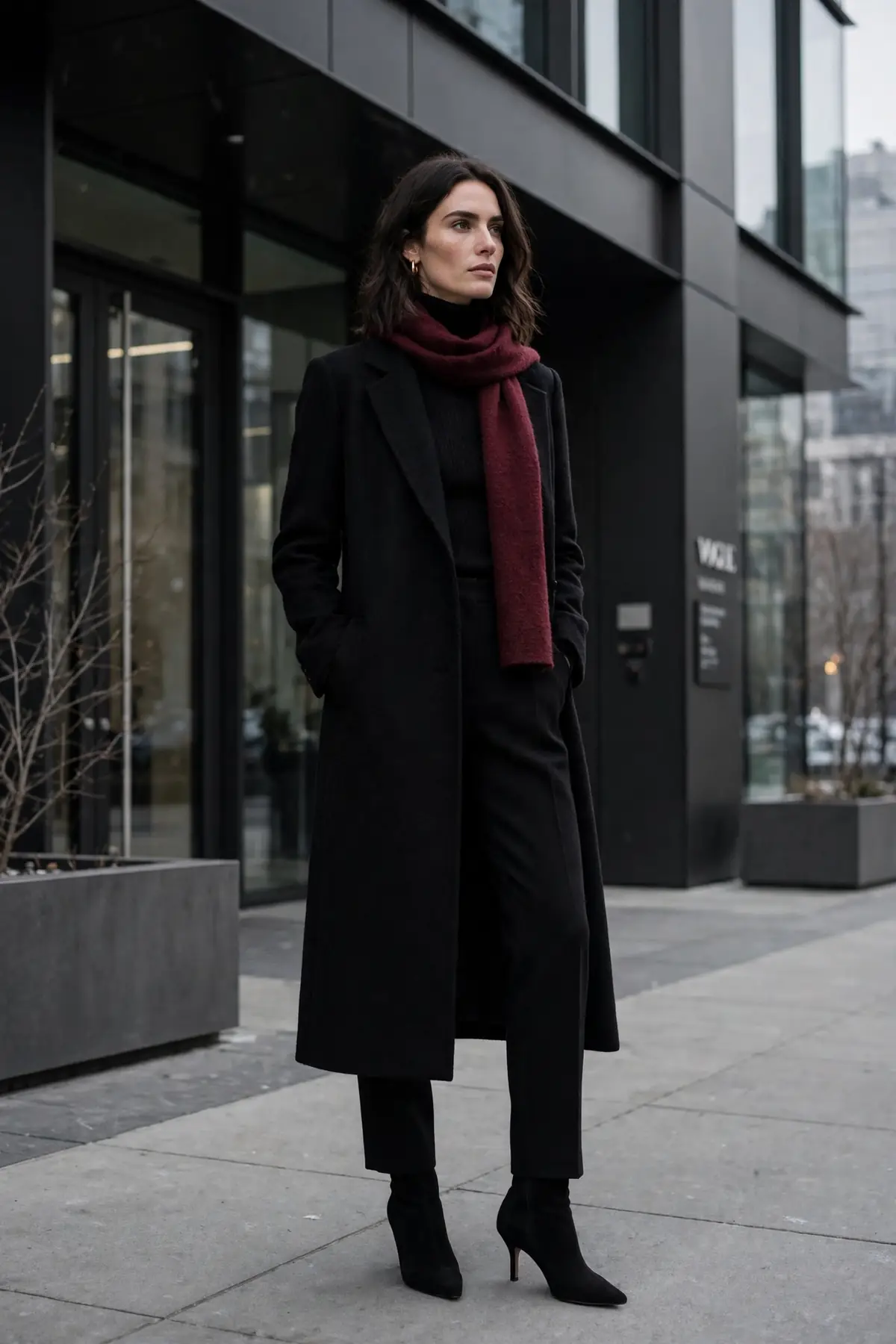
Specific formulas that work: a burgundy knit over charcoal wool trousers with a camel coat and heeled ankle boots; a cream turtleneck under a plaid midi skirt with knee-high boots and a dark wool coat; a satin blouse with tailored trousers, a long coat, and a structured tote. The scarf is your commute armor and your office accessory in one — wear it wrapped for the walk, then drape it over your chair or wear it loosely at your desk. And the shoe rule for offices: keep a pair of polished shoes at your desk if your commute demands snow boots. Nobody ever regretted the desk shoe drawer. Everybody has regretted the slush-soaked suede.
“Winter style is not about owning more clothes. It is about owning a system — one great coat, one great knit, boots you can walk in, and a scarf that does the talking.”
11. Fabric and care: making winter clothes last
Winter outfits 2026 are an investment, and investments need maintenance. Wool coats: brush them after wearing (a clothes brush takes 30 seconds and doubles a coat's life), hang them on wide wooden hangers, and never, ever hang a wet coat in a closed closet — let it air first. Knits: fold, never hang (hanging stretches knit shoulders into sadness), wash cold and flat-dry, and de-pill regularly with a fabric shaver — a $10 tool that makes a $40 sweater look like a $140 one. Leather boots: condition them monthly in winter, waterproof before the first wear, and stuff them with boot trees or rolled towels so they keep their shape.
Suede care deserves its own mention because suede fear keeps too many women from the prettiest winter boots: protector spray before first wear, a suede brush for salt marks (brush one direction, gently, when dry), and white vinegar on a cloth for stubborn salt stains. Faux fur: shake it out, spot-clean, and never put it in a hot dryer — heat is faux fur's enemy. And the storage rule for the end of the season: clean everything before you store it. Moths love dirty wool; a clean coat in a sealed bag in April is a coat you will still love in October. Winter clothes that last five years are not just sustainable — they are the cheapest clothes you will ever own.
12. The winter capsule: 15 pieces, endless outfits
If you want the whole guide in one shopping list, here it is — the 15-piece winter capsule that generates the 25 outfits above: a long wool coat, a hooded parka, three knits (cream, chocolate, burgundy), two pairs of trousers (charcoal wool, dark denim), a satin midi skirt, a pair of knee-high boots, a pair of ankle boots, a pair of snow boots, an oversized scarf, a leather tote, leather gloves, and a beanie. That is it. Fifteen pieces, worn in rotation, with the scarf and the coat doing the trend work and everything else staying classic enough to repeat for years.
The capsule works because it respects the real math of winter dressing: you wear your coat every day, your boots most days, and your knits on rotation — so those pieces deserve the budget, and everything else can be simple. It also respects your mornings: when every piece goes with every other piece, getting dressed takes three minutes instead of thirty, and the decision fatigue that makes winter mornings miserable simply disappears. That is the real promise of winter outfits 2026 — not more clothes, but better mornings. And honestly? A better January morning is worth more than any trend.
13. Winter outfits by temperature: the 40s, 30s, 20s, and below
Generic winter advice fails because "cold" is not one temperature. Here is the guide by actual degrees, the way you actually experience them. In the 40s (roughly 40-49°F), you need one good coat, not a system: a long wool coat over a knit and jeans, ankle boots, and a scarf you can remove indoors. This is the easiest winter weather to dress for, and the most common mistake is overdressing — a parka in 45-degree weather makes you sweat, and sweat is what actually makes you cold later. In the 40s, your coat should be wool, your knit should be medium-weight, and your boots should be leather, not snow boots. Save the heavy artillery.
In the 30s, the system kicks in: thermal base, chunky knit, long coat, knee-high boots, gloves, and a scarf wrapped twice. This is the temperature where the three-layer rule earns its keep, and where the coat length matters most — a hip-length jacket in the 30s leaves your thighs to fend for themselves, while a knee-length coat keeps your whole core warm. In the 20s, add the fourth layer: a quilted vest between your knit and your coat, fleece-lined trousers or tights under everything, and a hat that actually covers your ears. And below 20 degrees? This is not a fashion problem anymore, it is an engineering problem: a down parka rated for the temperature, insulated boots with real tread, a balaclava-style scarf arrangement, and hand warmers in your gloves. Nobody is judging your outfit at 10 degrees. Everybody is judging whether you are still standing.
The temperature guide also solves the indoor-outdoor problem that ruins so many winter outfits: offices and restaurants are heated to the 70s, and an outfit built for 25 degrees becomes a sauna indoors. The fix is layers you can remove gracefully — a coat that comes off to reveal a real outfit, a scarf that becomes an accessory rather than a burden, a knit that looks good on its own. If your winter outfit only works with the coat on, it is not a winter outfit. It is a coat with a hostage situation underneath.
14. The winter outfit mistakes to stop making
Mistake one: wearing your summer skin. Winter skin is drier, paler, and more sensitive, and the outfits that worked in September — bare legs, thin fabrics, light colors worn without a plan — do not translate. Tights are not a compromise; they are the tool that makes skirts work in January, and the 2026 tights story (opaque, patterned, burgundy) is genuinely good. Mistake two: the coat you hate but keep wearing because it was expensive. Cost-per-wear only works if you actually wear it with pleasure; a coat that makes you feel frumpy every single morning costs more in confidence than it ever saved in money. Sell it, donate it, replace it with one you love.
Mistake three: matching your bag, shoes, and belt exactly. The matchy-matchy set reads dated in 2026; the modern move is one color family, not one color — chocolate boots with a black bag, a burgundy scarf with a camel coat. Mistake four: forgetting that winter outfits are photographed from the waist up more than any other season's, because coats cover the rest — so the scarf, the earrings, and the neckline of your knit matter more than the jeans nobody can see. And mistake five, the biggest one: buying winter clothes in a panic in the first cold snap. The women with the best winter wardrobes bought their coats in October, when the selection was full and the prices were sane. Panic buying in January is how you end up with a coat you do not love at a price you do not like. This guide exists so that next October, you are the woman who already has the system.
15. Winter travel outfits: looking good at 30,000 feet and on arrival
Winter travel is where outfit systems prove themselves, because you have one bag, three climates, and a full day of transit. The travel formula that never fails: a long wool coat worn on the plane (never packed — it is too bulky and it is your blanket), a cream or charcoal knit, dark straight-leg trousers with stretch, and ankle boots you can walk a terminal in. The scarf is your pillow, your blanket, and your outfit's personality all at once — pack the oversized one, not the thin one. And the bag rule for travel: one structured tote that fits under the seat, holds your book, your water, and your gloves, and still looks like it belongs in a nice restaurant on arrival. A backpack says tourist; a structured tote says you live here now.
The packing trick is the capsule math from section 12, compressed: three knits, two bottoms, one coat, two pairs of boots maximum (wear the heavier pair, pack the lighter), and accessories doing the heavy lifting. Every piece must pair with every other piece, because a travel outfit that only works one way is dead weight. Roll your knits instead of folding them — less wrinkling, more space — and stuff boots with socks and scarves so no space is wasted. And the arrival rule: wear your best outfit on the travel day itself, not buried in the suitcase. You never know who you will meet between the gate and the hotel, and the woman who steps off the plane looking polished did not get lucky. She planned it, in the same way this whole guide plans it: system first, trends second, panic never.
16. Building your winter system over time (without blowing the budget)
Nobody builds a perfect winter wardrobe in one shopping trip, and you do not have to. The smart way to build the system is one hero per season: this year, the coat. Next year, the boots. The year after, the knit upgrade. Each hero lasts five-plus years when you buy quality and care for it properly, which means that within three years you own a winter wardrobe that looks like it cost a fortune and actually cost less than three years of panic purchases. The math is boring and the result is spectacular — that is the whole secret of good style, and it is especially true in winter, where the pieces are expensive and the season is long.
Start where your current wardrobe hurts most. If you hate your coat, start there — it is the piece the world sees. If your feet hurt every winter, start with boots. If you own five coats and nothing to wear under them, start with knits. And use the 30-wear test ruthlessly on every purchase from here on: can you picture 30 realistic wears, with things you already own, in the life you actually live? If yes, buy it and wear it hard. If no, walk away, no matter how good the sale is. Winter outfits 2026 are not about having more. They are about having a system — and now you have one. The cold does not stand a chance.
Winter outfits 2026 work best with one statement piece per look — the coat, the scarf, or the boots, never all three at once. Pick your star, keep everything else quiet, and the outfit reads expensive instead of busy.
| Piece | Style it with | Best for | Price range |
|---|---|---|---|
| Long wool wrap coat (camel) | Everything — jeans, skirts, tailoring | Daily hero | $120–$300 |
| Chunky cream turtleneck knit | Dark denim, wool trousers, midi skirts | Work + weekend | $35–$90 |
| Knee-high leather boots | Midi skirts, straight trousers, tucked jeans | All-day wear | $90–$220 |
| Oversized plaid scarf | Any neutral coat | Instant style upgrade | $20–$50 |
| Burgundy satin midi skirt | Fitted knits, heeled boots | Evenings + office | $30–$70 |
| Occasion | Formula | Key piece |
|---|---|---|
| Office | Cream knit + charcoal wool trousers + camel coat | Long wool coat |
| Weekend | Striped knit + wide-leg jeans + cropped puffer | Chunky loafers |
| Date night | Satin midi skirt + fitted knit + faux-fur coat | Knee-high boots |
| Snow day | Thermal + chunky knit + parka + snow boots | Oversized scarf |
| Holiday party | Velvet midi dress + heeled boots + long coat | Statement earrings |
- Monday office: cream turtleneck, charcoal wool trousers, camel coat, heeled ankle boots
- Weekend walk: shearling jacket, roll-neck knit, straight jeans, lace-up boots
- Date night: burgundy satin midi skirt, black fitted knit, knee-high boots, faux-fur coat
- Snow day: thermal base, chunky knit, hooded parka, snow boots, oversized scarf
- Emergency chic: all black in mixed textures, one bold scarf, heeled boots
Ready to build your winter system? Start with the heroes: long wool coats, knee-high leather boots, and oversized winter scarves are all affordable right now — before the deep-winter rush. For the runway side, Vogue’s fashion coverage tracks the season’s coat trends, Harper’s Bazaar covers winter street style, and ELLE’s trend reports follow the color stories — then check our shop picks and the journal for more seasonal guides.
What are the best winter outfits for 2026?
The defining winter outfits 2026 formulas are: a long wool coat over a cream turtleneck with dark trousers and knee-high boots; a burgundy coat over a satin midi skirt for evenings; and a hooded parka with a chunky knit and snow boots for the coldest days. The common thread is a hero coat, one great knit, and boots you can actually walk in.
How do you layer winter outfits without looking bulky?
Use three layers with one job each — a thin warm base, an insulating mid-layer, and a wind-blocking coat — and vary the lengths so the silhouette stays defined. Tuck the front of your knit in, and keep volume in one place only: big coat with slim bottoms, or chunky knit with a streamlined coat.
What colors are trending for winter 2026?
Chocolate brown, burgundy, plum, and bottle green lead winter 2026, with cream and ivory as the winter-white story. One bright accent — a cobalt knit, a cherry scarf — against neutrals is the runway trick that costs almost nothing to copy.
What boots go with winter outfits in 2026?
Knee-high boots in leather or suede are the default, flat riding styles for walking and heeled for evenings. Chunky-soled lace-ups handle ice, and Chelsea boots are the minimalist option. Buy for your calves, not just your feet, and waterproof suede before the first wear.
How do you dress warm for winter without sacrificing style?
Put the insulation in the coat, not in bulky sweaters: a thin merino base under a proper wool coat is warmer and slimmer than a chunky knit under a thin jacket. Add an oversized scarf as your style statement — it adds warmth and personality at once.
What is a good winter capsule wardrobe?
Fifteen pieces cover it: a long wool coat, a hooded parka, three knits, two pairs of trousers, a satin midi skirt, three pairs of boots, an oversized scarf, a leather tote, leather gloves, and a beanie. Every piece pairs with every other piece, so mornings take three minutes.
Can you wear suede boots in winter?
Yes — apply protector spray before the first wear and reapply monthly, brush salt marks off when dry, and use white vinegar on a cloth for stubborn stains. Suede boots in chocolate or taupe are worth the five minutes of maintenance.
How do you care for wool coats and knitwear?
Brush wool coats after wearing, hang them on wide hangers, and air them before storing. Fold knits instead of hanging them, wash cold and flat-dry, and de-pill with a fabric shaver. Always clean winter pieces before storing them for the season.
Part of the TrendThread hubs: Winter 2026 hub