TrendThread Journal
Fall Fashion 2026 — The Complete Guide
Every fall 2026 trend that matters, in one place — the coats, the knits, the colours, the layering rules and the Christmas outfits, with budget picks cheapest first and links to the full guides.
Fall 2026 is the season fashion got practical again. The coats have shoulders. The knits are soft enough to live in. The colours are rich, dark and warm — chocolate brown, burgundy, oxblood — with one vivid blue waiting in the wings for 2027. And the best news is the price tag: the most important pieces of the season start cheap. A good cashmere sweater costs fifty dollars now. A barn jacket that outlasts three winters starts under thirty. This guide puts the whole season in one place, so you can stop scrolling and start wearing it.
This is the hub for everything TrendThread published on fall 2026. Every section below is a short, honest summary of a full guide on this site — the coats, the sweaters, the colours, the layering rules, the budget picks and the Christmas outfits — with a link to the deep dive whenever you want the full formulas, the prices and the care notes. Nothing here is copied from another publication. It is our own reporting, rewritten and gathered into one guide you can actually use.
What is inside this guide
Coats first. The structured coat, plaid coats, barn jackets, long wool coats, teddy coats and faux fur, plus the full winter coat guide with the seven silhouettes that matter.
Knits second. Cashmere from $50, cable knits and Fair Isle — the three sweaters that carry the whole season.
Colour, layering and bottoms. Chocolate brown and burgundy, the season's defining pairing, and a look ahead at Luminous Blue, the 2027 Colour of the Year. Layering that works, leather trousers and knee-high boots.
The holidays. Thanksgiving, Christmas Eve, Christmas Day, the red dress, Christmas parties and ugly Christmas sweaters — plus the holiday outfits guide that ties them together.
The big picture. The fall fashion trends guide and the winter outfits guide for the season in full, and two wardrobe builders — the 12-piece capsule wardrobe and the fall wardrobe reset — for readers who want fewer, better pieces.
What is fall fashion 2026 really about?
Fall fashion 2026 is about structure, warmth and rich colour worn practically — tailored coats with real shoulders, soft knits you can live in, heritage checks like plaid, and deep shades of brown, burgundy and oxblood, all styled for cold mornings, warm afternoons and real budgets.
Three signals point the same way this season, and they are the same three we use to pick every trend on this site — runway and fashion-week coverage from the established fashion press, retailer bestseller and search data showing what people are actually buying, and street style, what stylish people wear in real life. When at least two of those signals agree, and the trend turns into outfits a normal person can wear to work, to dinner or on a weekend, it makes the guide.
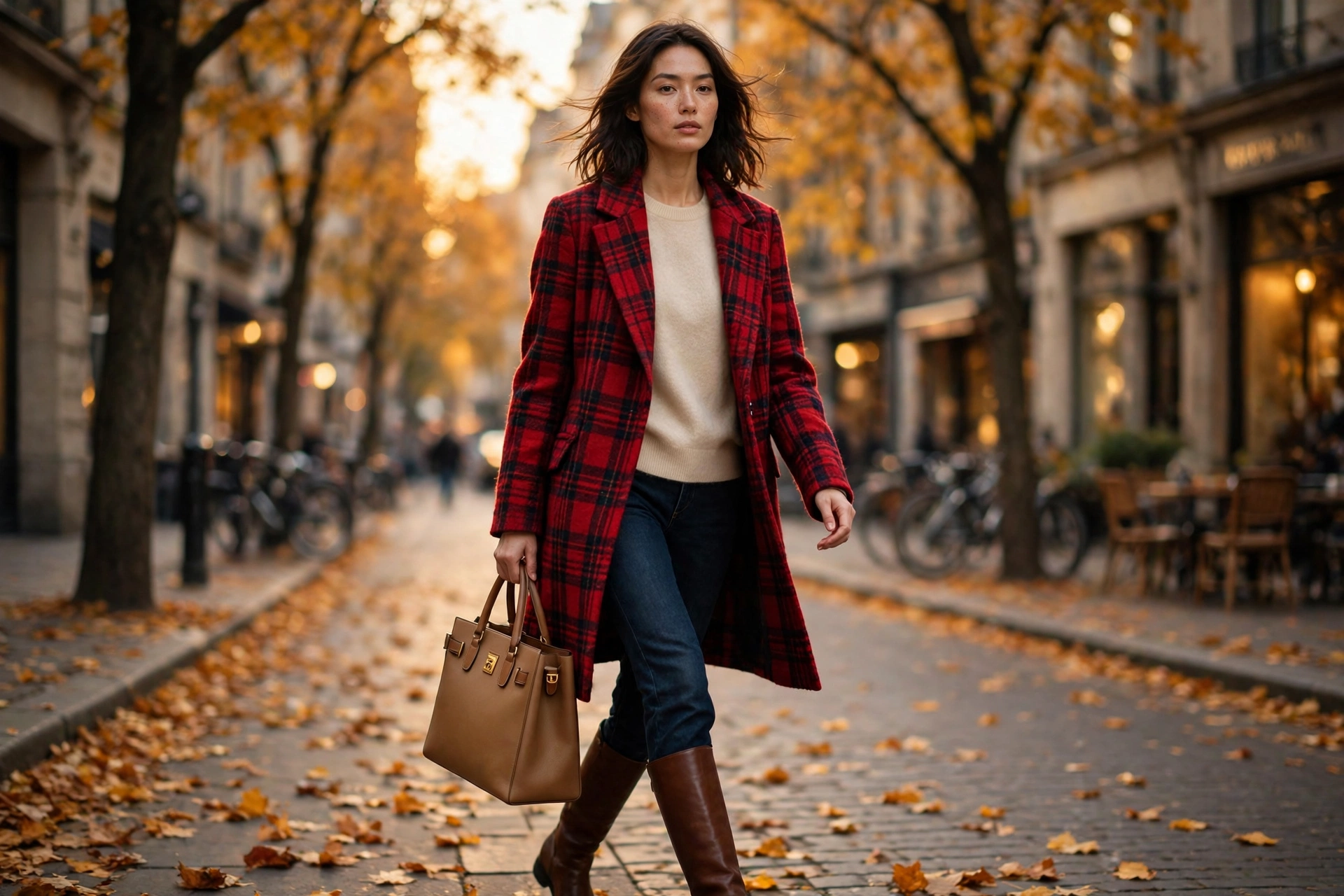
On the runways, the story was tailoring and texture. The structured coat — sharp, double-breasted, architectural — was the season's statement, and the heritage check came back on top in plaid coats, plaid skirts and tartan. In the shops, the winners were the practical pieces: the barn jacket, the long wool coat, the teddy coat, the cable knit. And on the street, the season looked like the photograph above — one strong coat, one soft knit, dark denim, tall boots, done in ninety seconds.
Colour is the other half of the story. Fall 2026 belongs to chocolate brown and burgundy worn together, to oxblood, to deep greens and creams, with leopard print still prowling in the background. And just past the season's edge, Luminous Blue — a deep vivid blue between cobalt and ultramarine — was named the 2027 Colour of the Year, which means the blue you buy this winter will still be the right blue next spring.
The honest version of the season is this: you do not need a new closet. You need one good coat, two good knits, one strong colour pairing and a pair of boots that go with everything. That is what this guide is built around. The rest is detail, and the detail is linked below.
Which coat should I buy first for fall 2026?
Buy the coat that matches your coldest regular day — a barn jacket or plaid coat for mild fall, a structured coat or long wool coat for sharp winter days, and a teddy or puffer when the temperature drops below freezing. One good coat beats three mediocre ones every time.
Start with the silhouette, not the colour. Our full winter coat guide breaks the season into seven silhouettes, and every coat on the market this winter is a version of one of them: the long wool coat, the long puffer, the teddy coat, the faux fur coat, the cape, the parka and the structured coat. Learn the seven and shopping gets fast, because you stop falling for coats that are just a new name on a shape you already own.
The structured coat — the sharpest investment
The structured coat is winter 2026's sharpest trend: tailored, double-breasted, with shoulders that hold their line. The fashion press put it plainly — a sharply tailored coat in black, white or crimson defines the silhouette with architectural precision — and each colour does a different job. Black is the workhorse, the closest thing winter has to a uniform. White is the statement, the one that makes a cream knit and tailored trousers look planned for a week. Crimson is the bold move for evenings. If you buy one structured coat, buy black, and read the structured coat guide for the five ways to wear it and the fitting-room checks that separate a good one from a costume.
The plaid coat — the loudest coat, the easiest outfit
Plaid coats are fall 2026's headline outerwear, and the styling is easier than the print suggests. The rule from our plaid coat guide is one check at a time: a red plaid coat over an all-black base — black turtleneck, black straight-leg jeans, black knee-high boots — is a complete outfit in ninety seconds, because the coat is the entire outfit and the black underneath just frames it. A black-and-white houndstooth coat over a cream blouse and tailored charcoal trousers reads as almost a neutral at work. An oversized check is the weekend version. Plaid coats run about $30 to $65 on the budget end, and the fabric rule matters more than the price: a wool-blend plaid holds its shape and keeps you warm, while thin shiny plaid looks like a costume by December.
The barn jacket — the most wearable coat of the season
If the structured coat is the sharpest and the plaid coat is the loudest, the barn jacket is the most wearable. Our barn jacket guide calls it the farm coat that took over fall 2026, and the case is simple: boxy, weatherproof, endlessly layerable, cheaper than your last impulse blazer. The classic is still the one to beat — a bark or olive waxed cotton body with a tan corduroy collar and brass snaps — and it ages beautifully. The cropped version hits at the waist and pairs with high-waisted jeans and midi skirts. Budget barn jackets run about $28 to $65, and the care note is real: waxed cotton needs re-waxing now and then, and it is the only coat here that genuinely gets better with wear.
Long wool, teddy and faux fur — the warmth ladder
When the temperature drops, the choice is about warmth per dollar. A long wool coat — single or double-breasted, hitting below the knee or at the shin, in camel, black, grey or chocolate — is the most polished option and the one that makes jeans look intentional, from about $90 to $250. A teddy coat is the hug of the season: curly faux shearling, usually cream or caramel, in cropped, longline and maxi lengths, from about $50 to $220 — the trick is keeping the rest of the outfit slim so you do not look like a bear. A faux fur coat owns the evening end of fall 2026 in deep brown, cream, burgundy and even pink, and if the full coat feels like too much, start with faux fur trim on a collar or cuffs. For the coldest days, the long puffer is simply the warmest thing you can buy, full stop — and the winter coat guide explains fill power, wool percentages and temperature ratings so you can tell a genuinely warm coat from a puffy one.
The rest of the seven silhouettes fill the gaps the big coats leave. The long puffer is the coldest-day answer — knee-length or longer, filled with down or synthetic insulation, with a hood — and the grown-up version of it is the one our winter coat guide recommends: matte fabric, clean lines, no shiny plastic look. The quilted jacket is the smart layer to buy when a puffer is too much and a wool coat is too dressy: warm without bulk, and the cosy cousin of the barn jacket. The cape is the statement coat, the one that turns jeans and a turtleneck into an outfit, and the parka is the practical one, the coat for snow, slush and school runs. Capes, parkas and statement coats get their own section in the winter coat guide, along with the warmth question that decides between them all — how warm is warm enough — answered with fill power, wool percentages and temperature ratings instead of guesswork. The short version is this: check the label, not the puff. A coat's warmth lives in its fill and its fabric, and a thin coat with good insulation beats a thick coat with none.
What are the best sweaters for fall 2026?
The best sweaters for fall 2026 are cashmere for softness, cable knit for warmth and Fair Isle for pattern — and the best news is that cashmere now starts at $50, so the season's most luxurious knit is also one of its cheapest buys.
Cashmere is the headline because the price story changed. A good cashmere sweater used to mean a luxury-only price tag. Not anymore. Our cashmere guide puts it plainly: the cheapest good cashmere on the market right now costs fifty dollars — the Quince Mongolian Cashmere Crewneck at $50, Grade-A Mongolian cashmere, two-ply, in a classic crewneck shape that works with everything. Next up the ladder is the Everlane Cashmere Classic Crew at $95, a slightly slimmer, more polished cut. The quality rules are the same at any price: Grade-A means the longest, finest fibres, which means less pilling; two-ply is denser, warmer and more durable than single-ply; and real cashmere feels cool and silky when you first touch it, then warms up in your hand. Read the reviews and search for the word pilling — if twenty reviewers mention it, believe them. Seven outfit formulas and the wash-and-care routine that keeps cashmere soft for years are in the full guide.
Cable knit is the season's workhorse. Our cable knit guide has seven outfits you will actually live in, and the fit rule is the whole game: chunky does not mean shapeless. A cable knit should skim, not swallow — half-tuck it, belt it, or wear it over a collared shirt so the texture has structure around it. Cable knits are also team players in a layered outfit, which is why they show up again in the layering section below. Budget cable knits start very low, and the same quality checks from the cashmere guide apply — long fibres, tight knit, no pilling in the reviews.
Fair Isle is the pattern story of winter 2026. Our Fair Isle guide traces it to a tiny Scottish island and a very big knit, and explains the two-second difference from argyle before getting to the six formulas that actually work. The classic palette is cream, rust, brown and sage — the colours of the Shetland landscape, and the combination that will never look wrong. A cream base with rust and brown diamonds is the safest first buy: it goes with dark denim, black trousers and camel coats. Budget Fair Isle starts around $25 to $40, and the 2026 twist is a punchier palette for readers who want the heritage pattern with more energy.
Care is the difference between a sweater that lasts one season and one that lasts five. Cashmere gets a gentle hand wash or a cold delicate cycle, dried flat — never hung, because a wet knit stretches under its own weight — and rested between wears so the fibres recover. Cable knits get the same treatment, plus a de-pilling comb once a month, because pilling is not a defect, it is friction, and it happens to every knit eventually. Fair Isle keeps its shape best folded, not hung, and kept away from moths with cedar, not chemicals. None of this is difficult. It is ten minutes a month, and it is what turns a $50 sweater into a five-year sweater.
One more knit deserves a mention before we move on: the sweater dress. It is the one-piece answer to cold mornings — warmth without bulk, an outfit without decisions — and the knit co-ord set is its even lazier cousin, a matching top and bottom that looks intentional with zero effort. Both are covered in the cashmere guide's companion reading, and both pair with the knee-high boots in the section below.
What colours define fall 2026?
Chocolate brown and burgundy worn together define fall 2026, with oxblood, deep green and cream as support — and Luminous Blue, the 2027 Colour of the Year, is the vivid blue to buy now for next spring.
The pairing works because of undertone, and our chocolate brown and burgundy guide makes it the one rule that matters: match warm with warm and the two shades melt together; mix warm and cool and they fight. Three formulas carry the whole pairing. The tonal column — head-to-toe brown with a burgundy bag or lip — is the most elegant. Burgundy as the statement — a burgundy coat or dress over a brown base — is the easiest. Brown grounds, burgundy lifts — brown trousers, a burgundy knit — is the everyday version. Accessories are where the duo shines cheapest: a burgundy bag, brown boots, a gold earring, and the outfit is done.
Oxblood is burgundy's darker, moodier sibling and it runs through the season's accessories and leather — the shade that makes black feel boring by comparison. Leopard print is still prowling too, the season's most durable pattern, and it behaves like a neutral once you treat it that way: one leopard piece, everything else quiet. For readers who want colour with more energy, the 2027 forecast is already here: Luminous Blue outfits for 2027 — WGSN and Coloro named Luminous Blue the 2027 Colour of the Year, a deep vivid blue between cobalt and ultramarine, and the spring 2027 runways already proved it works everywhere from tinsel gowns to white jeans. Six outfit formulas, the fabrics that make the blue sing, and budget picks from about $18 to $55 are in the full guide. Buy the blue now, while it is still a discovery, and wear it into spring.
Leopard print deserves its own note because readers keep asking whether it is still in style, and the answer from our guides is that it never really left — it just stopped being a statement and became a neutral. Treat one leopard piece the way you would treat a neutral: a leopard coat over black, leopard boots with dark denim, a leopard scarf with a camel coat. One piece, everything else quiet, and the print reads as texture rather than noise. Cream plays the opposite role in the season — the peacemaker. When burgundy and chocolate brown feel too dark together, cream breaks them up. When Luminous Blue feels too vivid, cream softens it. A cream cashmere crewneck is the single most useful piece in the whole colour story, because it goes with every shade in this guide and makes every outfit look finished.
| Colour | Wear it with | Best first buy |
|---|---|---|
| Chocolate brown | Burgundy, cream, gold | Brown trousers or boots |
| Burgundy | Chocolate brown, black, velvet | Burgundy knit or velvet dress |
| Oxblood | Black, cream, leather | Oxblood bag or boots |
| Luminous Blue | White, red, orange | Blue knit or dress |
| Cream | Everything — the season's peacemaker | Cream cashmere crewneck |
How do I layer for fall without looking bulky?
Layer thin to thick, fitted inside and structured outside, with only one bulky piece per outfit — a thin base, a mid-layer that skims, and a coat with real shoulders does the work that three puffy layers never will.
Fall is the hardest layering season because the temperature swings twenty degrees between morning and afternoon, and the fix is not more layers but better ones. Start with a thin base that sits close to the body — a fitted tee, a thin turtleneck, a silk camisole. Add one mid-layer with texture — a cable knit, a Fair Isle sweater, a quilted jacket — and finish with a coat that has structure, because a structured coat over a soft knit is what keeps the whole outfit from going shapeless. The coat does the tailoring so the knit does not have to.
Two practical rules from our guides. First, the one-bulk rule: one oversized or chunky piece per outfit, everything else fitted. An oversized plaid coat works over slim jeans and a thin knit; it does not work over a chunky cable knit and wide-leg trousers. Second, show the layers on purpose — a shirt collar over a crewneck, a knit cuff past a coat sleeve, a scarf that is actually part of the outfit. Layers that peek out look deliberate; layers that bunch up look like you got dressed in the dark.
A few formulas to steal. The shirt under the knit — a collared shirt with the collar and cuffs showing under a crewneck — adds structure to a soft outfit and costs nothing, because the shirt is already in your closet. The knit over the dress — a chunky cable knit over a slip dress or a satin midi — turns a summer dress into a fall outfit and a party dress into a daytime one. The scarf as the outfit — a large wool scarf worn as a shawl over a coat — is the cheapest layer you own and the warmest one per dollar. And the open third layer — a barn jacket or quilted jacket worn open over a knit, never buttoned — shows the layers instead of hiding them, which is the whole point.
The pieces that layer best this season are the ones built for it. Quilted jackets are the smart layer to buy — warm without bulk, and the cosy cousin of the barn jacket. A funnel-neck jacket frames the face and kills the need for a scarf. And the cable knit, as its guide says, is a team player: over a collared shirt, under a barn jacket, under a long wool coat, it works in all three positions. For the bottom half, the same logic applies — one statement, the rest quiet — which is where leather trousers and plaid skirts come in.
What do I wear with jeans this fall?
Dark straight-leg jeans with a strong top half — a plaid coat, a cashmere crewneck, or leather trousers swapped in when jeans feel too casual — finished with knee-high boots, because tall boots are the shoe that makes every fall outfit look finished.
Jeans are the base of the season, and the formulas are simple. The ninety-second outfit is the red plaid coat over an all-black base — black turtleneck, black straight-leg jeans, black knee-high boots. The office outfit is a houndstooth coat over a cream blouse and tailored charcoal trousers. The weekend outfit is an oversized check with straight-leg jeans and loafers. All three are in the plaid coat guide, and all three start from jeans you already own.
When jeans feel too casual, leather trousers are the upgrade — twelve outfits in our guide, from office to weekend to night out, in wide-leg, barrel-leg, straight and flared silhouettes. The honest math on real versus faux leather is in the full guide: real leather costs far more and lasts far longer, while good faux leather at a fraction of the price is the right buy if you are trying the trend for one season. The fit rules matter more than the material — forget everything you know about leather trousers being tight, because the 2026 versions are relaxed, high-waisted and made to move.
Knee-high boots are the shoe of the season, and the guide's over-or-under rule fixes every outfit: skirts and dresses go over the boot or under it deliberately, never caught halfway. Shaft height matters — the boot should end where your leg looks longest, usually just below the knee — and heel height is a wear-all-day decision, not a fashion one. Black is the workhorse, brown is the warmer choice with chocolate brown outfits, and burgundy is the colour move that ties the whole season together. Suede needs protecting before the first rain, and leather needs conditioning before the first snow.
How do I build a fall wardrobe on a budget?
Buy cheapest first, one hero piece per category, and spend the most on the coat and the boots — a $50 cashmere crewneck, a $28 barn jacket and a $25 Fair Isle sweater cover the season's knits and outerwear for about the price of one luxury knit.
TrendThread's rule is lowest-budget first: the cheapest good pick leads every list, and the premium version only earns its place if it genuinely lasts longer or fits better. The table below is the whole season's budget, taken from the price ranges in our own guides — cheapest picks first, no invented prices.
| Piece | Cheapest good pick | Price range in our guides |
|---|---|---|
| Cashmere crewneck | Quince Mongolian Cashmere Crewneck | From $50 |
| Barn jacket | Classic waxed cotton barn jacket | $28–$65 |
| Plaid coat | Wool-blend plaid coat | $30–$65 |
| Fair Isle sweater | Heritage Fair Isle crewneck | $25–$40 |
| Teddy coat | Longline teddy coat | $50–$220 |
| Long wool coat | Single-breasted wool coat | $90–$250 |
| Ugly Christmas sweater | Party-ready novelty knit | $15–$30 |
| Red Christmas dress | Fit-first red midi dress | $35–$150 |
Three budget rules make the table work. First, the cost-per-wear rule from our 30-wear test guide — a $50 cashmere sweater worn thirty times costs less per wear than a $15 sweater worn twice, so cheap only counts if you actually wear it. Second, the capsule rule from our 12-piece capsule wardrobe — twelve pieces that all work together beat thirty pieces that do not, and the capsule is the fastest way to stop impulse buying. Third, the reset rule from our fall wardrobe reset — before you buy anything, pull everything out, try it on, and write down the three gaps. Most readers find they already own the jeans, the boots and the black base layers, and the only real gaps are one coat and one knit.
The math is worth doing once, because it changes how you shop. A $50 cashmere sweater worn thirty times costs $1.67 per wear. A $150 long wool coat worn five winters, sixty times a winter, costs fifty cents per wear. A $30 trend piece worn twice costs $15 per wear — ten times the cashmere. That is the whole budget argument in three numbers: the expensive-looking buy is usually the cheap one, and the cheap-looking buy is usually the expensive one, once you count the wears. Our winter coat guide makes the same point from the other side, in its budget versus luxury section: the extra money buys better fabric, better insulation and a better fit, and those three things are exactly what make a coat last five winters instead of one.
Ready to shop cheapest first? Start with a cashmere sweater for women, add a barn jacket, and finish with a plaid coat. Budget first, premium second — and check the current price, material, sizing and availability on the product page before you buy, because prices move.
What should I wear to Thanksgiving 2026?
A knit midi dress is the Thanksgiving hero — one piece, comfortable after dinner, polished in photos — with a satin skirt and soft sweater as the festive middle ground and tailored trousers that feel like loungewear as the backup.
Thanksgiving has one non-negotiable rule and our Thanksgiving guide states it plainly: dress for the oven, not the photo. You will be cooking, reaching, sitting for hours and eating a large meal, so the outfit has to move, breathe and forgive. The knit midi dress does all three — it is the one-and-done hero, comfortable, warm and photogenic, from about $45 to $100. The satin skirt and soft sweater is the festive middle ground: the satin brings the occasion, the sweater brings the comfort, and together they photograph beautifully. Tailored trousers that feel like loungewear — elastic waists, soft fabrics, clean lines — are the third option, and the one hosts reach for most.
Shoes and outerwear are the finishing decisions. Wear the boots you can stand in for four hours, not the heels you love in the mirror. Bring a coat you can throw on for the walk — a barn jacket or a long wool coat both work — and remember the family photo rule: one statement piece, everything else quiet, so the photo looks like you and not like your outfit.
What should I wear to Christmas 2026?
Christmas dressing has one rule per day — burgundy velvet and candlelight on Christmas Eve, a knit dress and comfort on Christmas Day, a red dress for the moment that matters, and one statement only at the party — with the full formulas in our Christmas guides.
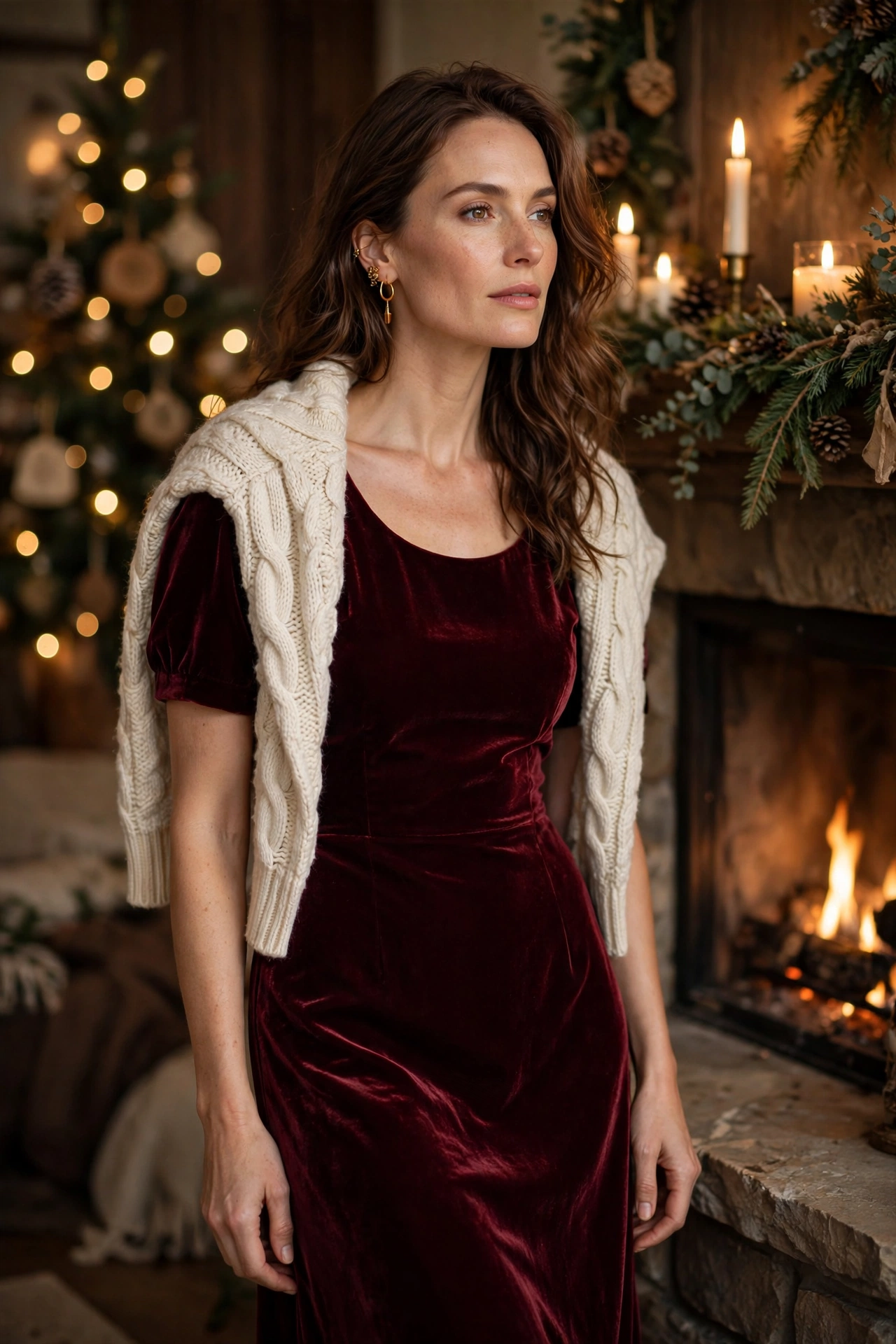
Christmas Eve is the candlelight night, and our Christmas Eve guide builds it around one rule: the candlelight rule, which says the outfit should look good in low, warm light. The hero piece is burgundy velvet — a velvet dress, a velvet skirt, a velvet blazer — because velvet drinks candlelight and looks expensive without trying. Church and carols get the early-evening version, dinner at home gets the festive-but-comfortable version, and dinner out gets the dressed-up version, all in the full guide, with prices from about $50 to $250.
Christmas Day is the longest day of the season and the most comfortable one. Our Christmas Day guide leads with the knit dress — the hero of Christmas Day — and the satin skirt with a chunky knit as the second option, because both survive a full day of family, food and photos. The tunic and the co-ord are the honest easy answers, and the guide's colour, layering and walk sections cover the rest, from about $35 to $180.
The red dress deserves its own moment because it is the most-searched colour of the season. Three things decide it, in this order: the shade, the fabric and the fit. Find your red first — blue-reds for cool skin, warm brick reds for warm skin — then let the fabric decide the room, because velvet reads evening, satin reads party and crepe reads polished. Fit rules matter more than size, and the full guide covers what to wear with a red dress, red for every Christmas moment, and what not to do, from about $35 to $150.
Parties get their own formula in our Christmas party guide: velvet is the safest bet in the room, satin is the after-five shortcut, and sequin works under the one-statement rule — one sequin piece, everything else quiet. Jumpsuits and tailored separates are the options for readers who do not want a dress at all. And for the party that is not a party at all, the ugly Christmas sweater guide has fifteen cute ways to wear one, including the office party version, the family version and the couples version, with finds under $30. Tie it all together with our holiday outfits guide, which covers the whole season from the first party to New Year's Eve.
Shoes and accessories decide whether a Christmas outfit reads festive or costume, and the party guide's advice is consistent across every event. Shoes should be the pair you can stand in for four hours — a block heel, a pointed flat, a knee-high boot — because a party is mostly standing, and sore feet show in photos. Accessories should do one job each: gold jewellery warms up burgundy and velvet, a small structured bag keeps the outfit polished, and a red lip is the cheapest statement in the room. Colours that read festive without reading costume are the season's own palette — burgundy, deep green, gold, cream — and the mistake to avoid is adding a new festive colour on top of them. The outfit already has a colour story. Let it finish the sentence.
What fall 2026 trends should I skip?
Skip the cheap, shiny version of every trend — thin polyester plaid, single-ply cashmere that pills, faux fur that sheds, and head-to-toe anything — because the trend is never the problem, the fabric and the styling are.
The skips in our guides are consistent, and they are worth listing in one place. Skip the head-to-toe look in any single print or colour — head-to-toe plaid, head-to-toe velvet, head-to-toe anything — because one strong piece is a statement and five is a costume. Skip thin, clingy polyester in any trend, because it goes see-through, goes shiny and pills by the second wash. Skip single-ply cashmere if you want the sweater to last, and skip any knit whose reviews mention pilling more than twice. Skip the faux fur coat that sheds in the shop — it will shed on your black trousers for a year. Skip the heavy winter coat in a spring shade, or the spring piece in a winter weight — the wrong weight for the season is the version of the trend that looks off. And skip buying five mediocre pieces when one good one would do: the cheapest version of a trend you wear twice is the most expensive outfit you own.
The positive version of the same advice is the 30-wear test: before you buy, ask whether you will wear it thirty times. If the answer is yes, the price is almost always justified. If the answer is no, the price is almost always wasted.
How do I make one fall wardrobe work from September to December?
Build a small capsule around one coat, two knits, dark jeans and tall boots, then change the layers and the colour, not the clothes — the same twelve pieces carry September to December if the coat is warm enough and the knits layer cleanly.
September is barn jacket weather: the waxed cotton layer over a tee, with jeans and loafers. October adds the knit — cashmere crewneck under the barn jacket, or a cable knit on its own. November brings the plaid or structured coat, the knee-high boots and the burgundy. December is the long wool coat, the teddy coat and the velvet. The clothes barely change; the layers and the warmth do. That is the whole trick, and it is why the capsule works: our 12-piece capsule wardrobe is twelve pieces that all work together, and our fall fashion trends guide and winter outfits guide map the season in full for readers who want the complete picture.
Before you buy anything for the season, run the fall wardrobe reset: pull everything out, try it on, keep what fits and flatters, and write down the three real gaps. Most readers find the gaps are one coat, one knit and one pair of boots — and this guide just told you which ones, cheapest first.
Fall 2026 is not only a women's season. The same rules — one good coat, one strong colour, cheapest first — apply to men's outfits, and the accessories do the heavy lifting. Our men's guides cover the three finishing pieces: the best watches for men, the best sneakers for men and the best leather wallets for men. A clean watch, white sneakers that are actually white, and a leather wallet that is not falling apart will lift a barn jacket and jeans further than another jacket will. Men's seasonal guides are a growing part of TrendThread — the site now covers men's and women's fashion side by side, budget first in both.
Fall Fashion 2026 FAQs
What is the biggest fall fashion trend of 2026? The structured coat and the plaid coat share the top spot — tailored, double-breasted coats with real shoulders, and heritage plaid in red tartan and houndstooth. Behind them, the barn jacket is the most wearable buy of the season.
How much should a good cashmere sweater cost in 2026? From $50. The Quince Mongolian Cashmere Crewneck at $50 is the cheapest good cashmere in our guide — Grade-A Mongolian cashmere, two-ply — with the Everlane Classic Crew at $95 as the next step up.
What colours go with chocolate brown for fall 2026? Burgundy first, then cream, gold and oxblood. The chocolate brown and burgundy pairing is the season's defining colour story, and the one rule is to match warm undertones with warm undertones.
What coat should I buy if I can only buy one? A barn jacket for mild fall, a structured coat in black for sharp winter days, or a long wool coat if you want one coat for everything. Buy for your coldest regular day, not your coldest day ever.
What do I wear to Christmas Eve 2026? Burgundy velvet under the candlelight rule — a velvet dress, skirt or blazer that looks good in low, warm light — with one statement only and everything else quiet.
Is Luminous Blue a fall 2026 colour? Not quite — Luminous Blue is the 2027 Colour of the Year, named by WGSN and Coloro. It starts appearing now and leads spring 2027, so buying a blue knit this winter means wearing the right blue into next season.
That is the season. One good coat, two good knits, one strong colour pairing, boots that go with everything — and the full guides linked above whenever you want the formulas, the prices and the care notes. Fall 2026 rewards the practical shopper: buy the cheapest good version first, wear it thirty times, and let the coat do the talking.
Start with a cashmere sweater for women, a barn jacket and a plaid coat — budget first, premium second — and check the current price, material, sizing and availability on the product page before you buy.