TrendThread Journal
How to wear oxblood without making the outfit feel heavy
Treat the shade as a near-neutral. A burgundy bag with charcoal, a wine knit with washed denim, or an oxblood shoe under camel creates depth without drama.
Oxblood is the color that sounds dramatic and wears like a neutral. Say it out loud — oxblood — and it conjures velvet curtains and old libraries. Wear it, though, and something much more useful happens: it deepens everything around it without shouting. Treat the shade as a near-neutral and the whole color stops being scary. A burgundy bag with charcoal, a wine knit with washed denim, or an oxblood shoe under camel creates depth without drama, and that is exactly why oxblood has quietly become fall's most wearable rich color.
The trick is to stop thinking of oxblood as “a red” and start thinking of it as “a dark.” Dark colors recede, they ground an outfit, they make brighter pieces look intentional instead of loud. Oxblood does all of that while adding warmth that black and navy cannot. It is the difference between an outfit that looks correct and an outfit that looks alive. And unlike brighter reds, it flatters nearly everyone, because its depth does most of the work — you do not have to be bold to wear it, you just have to wear it.
First, find your oxblood. The family runs from bright burgundy to deep wine to almost-brown oxblood, and the right one for you depends on undertone. If gold jewelry looks better on you than silver, lean warm: browns and rusts in the mix. If silver wins, lean cool: wines with a plum edge. Hold the fabric near your face in daylight. The right shade makes you look rested; the wrong one makes you look like you need a nap. That test takes ten seconds and saves you from a drawer full of almost-right knits.
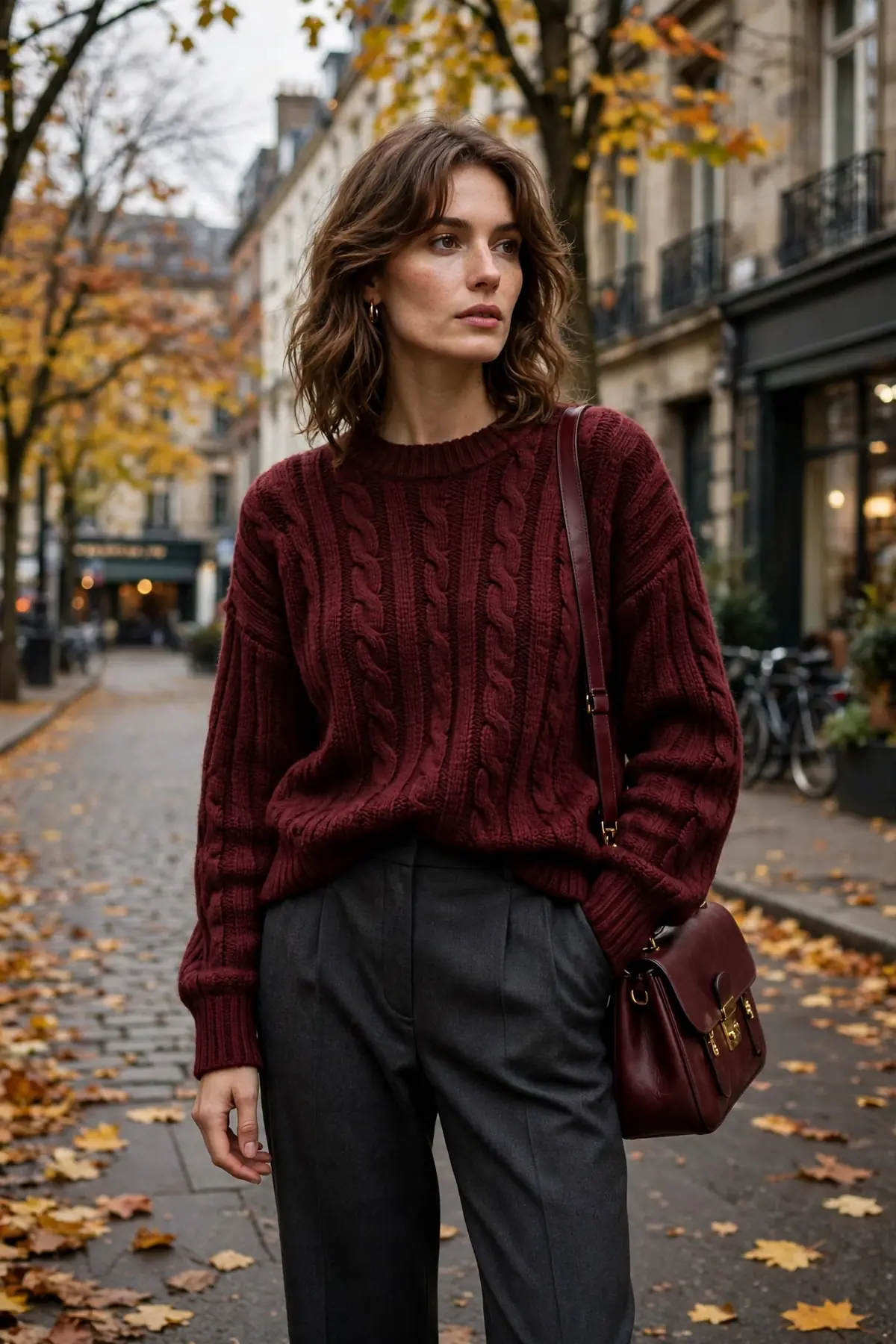
The easiest oxblood outfit: wine knit, washed denim
If you buy one oxblood piece this season, make it a knit. A wine-colored sweater with washed, mid-blue denim is the outfit equivalent of a perfect Sunday: easy, flattering, impossible to get wrong. The denim lightens the wine so it never feels heavy, and the wine makes the denim look dressed up without any effort at all. Add white sneakers or tan loafers, a simple gold hoop, and you are done. It is the kind of outfit that looks like you tried and feels like you did not, which is the highest compliment a weekday outfit can get.
Texture matters here more than silhouette. A chunky cable knit in oxblood reads cozy and expensive; a fine merino version reads polished and office-ready. Both work with the same jeans, which means one color can cover two very different days. If your knit is oversized, half-tuck it or pair it with a slimmer jean so the proportions stay balanced — the same proportion rule that governs wide-leg denim applies here: volume on one half, definition on the other.
Oxblood at work: charcoal, camel, and one deep shoe
For the office, oxblood is a secret weapon, because it reads as serious without reading as severe. Charcoal trousers with an oxblood blouse, or a charcoal dress with oxblood shoes, gives you the polish of an all-dark outfit with a pulse. The shoe version is especially clever: an oxblood loafer or low heel under charcoal or navy trousers adds color exactly where it is noticed — at ground level, in motion — without ever distracting in a meeting.
Camel is oxblood's best friend at work and everywhere else. A camel coat over an oxblood knit, or an oxblood bag against a camel coat, is one of those pairings that looks expensive because the tones are both warm and deep. It is also the pairing to reach for when you want to look put-together on a day when you feel anything but. Throw the coat over anything — jeans, a dress, tailoring — and the oxblood detail underneath does the talking. For more on the tailoring side of this, soft tailoring for hybrid work shows how an unstructured blazer keeps exactly this kind of outfit comfortable all day.
Evening oxblood: let it be the star, once
In the evening, oxblood can finally take center stage — but still only once per outfit. An oxblood satin dress, or a velvet blazer in deep wine, with everything else quiet: black trousers, simple shoes, minimal jewelry. The fabric does the drama, so you do not have to add more. Velvet and satin are oxblood's natural evening textures; they catch light the way flat cotton cannot, and they turn a simple shape into something that looks like an occasion.
The mistake to avoid is doubling up: oxblood dress plus oxblood shoes plus oxblood bag reads like a uniform, not an outfit. Pick the hero piece, then go quiet everywhere else. Black is the obvious companion, but charcoal and deep navy are softer and often more flattering — they let the wine stay warm instead of turning it harsh under evening light. One deep lip in a matching tone ties it together, and then stop. The restraint is the style.
Oxblood accessories: the low-commitment way in
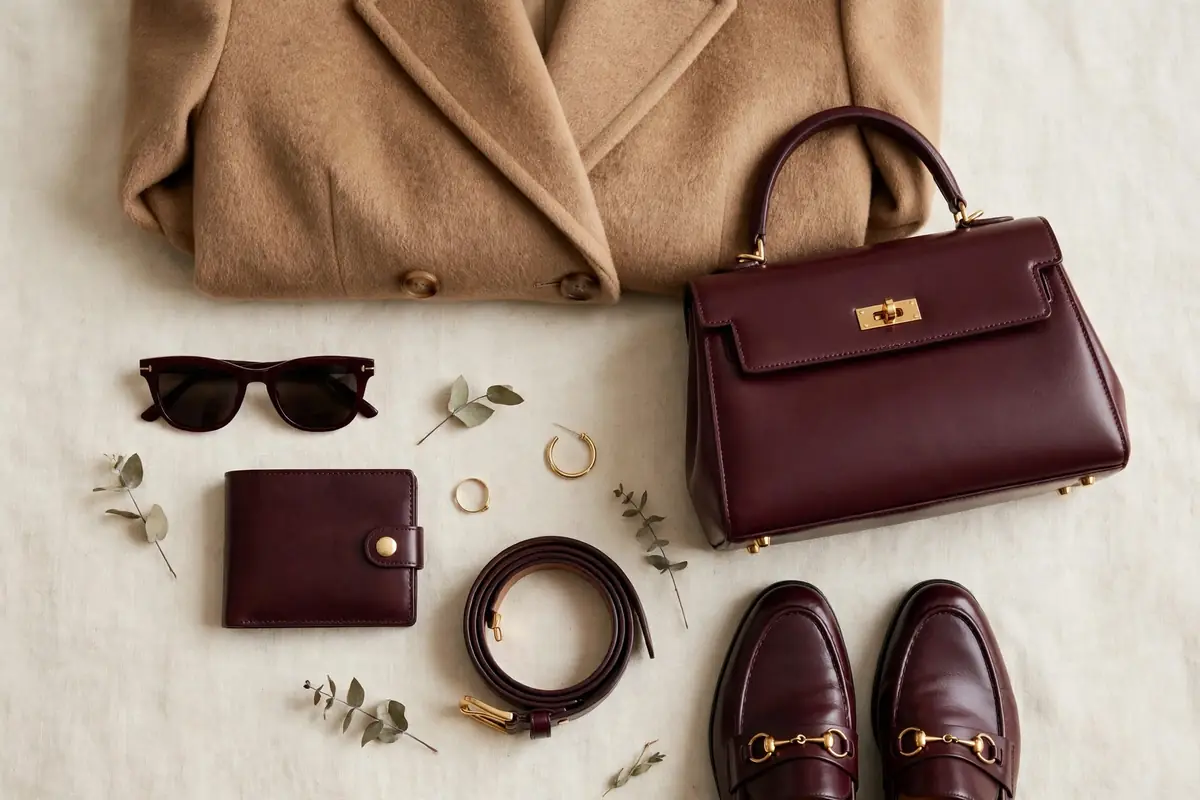
Not ready for a wine sweater? Start with accessories, where oxblood is almost unfairly effective. A burgundy leather bag is the single best accessory purchase of fall, because it goes with black, navy, charcoal, camel, cream and denim — genuinely everything in a normal closet. Shoes are next: oxblood loafers or boots break up an all-neutral outfit without introducing a color you have to plan around. Even a scarf or a belt in oxblood can rescue a tired outfit, because the eye reads it as intentional color, not an accident.
When you shop accessories, check the leather tone in daylight and against your most-worn coat. Oxblood bags that look brown indoors and purple outdoors are common, and neither is wrong — but you should know which one you are buying. The best test is the coat test: hold the bag against your camel, black and navy coats in turn. If it flatters all three, it is a keeper. If it only works with one, it is a specialist, and specialists should be bought deliberately, not impulsively.
What not to pair with oxblood
A few honest warnings. Bright, cool reds fight with oxblood — they make each other look muddy, like two people talking at once. Neon anything is a no; oxblood's whole charm is depth, and neon kills depth on contact. Very pale pastels can work, but only in small doses — a cream knit under an oxblood coat is lovely, while head-to-toe pastel-plus-wine looks confused about which season it is. And be careful with animal print: a little leopard with oxblood is gorgeous, a lot of leopard with oxblood is a lot of everything at once.
The other trap is weight. Oxblood in heavy fabrics — thick wool, leather, velvet — all at once can feel literally and visually heavy. Balance it: a leather oxblood skirt with a light knit, a heavy oxblood coat with a simple dress underneath, a velvet blazer with plain trousers. The color is rich enough; the outfit does not need to be rich in every texture too. Think of oxblood as the bass note. It grounds the song, but it is not the whole band.
Keeping oxblood looking good
Deep colors show fading faster than black does, so care is part of the styling. Wash wine knits cold and inside out, keep leather bags out of direct sun when you are not wearing them, and treat suede in oxblood with protector before the first rainy day, not after. If a knit starts to fade at the elbows or cuffs, that is not a failure — it is a sign it was loved — but it is also a sign to rotate it with another piece before it becomes the faded one you only wear at home.
Oxblood beyond fall: the color that travels
One more reason to invest in oxblood is that it refuses to stay in one season. In winter it deepens beautifully against charcoal coats and winter white, giving cold-weather outfits a warmth that black alone cannot. In spring it softens into a lip color, a bag, or a light scarf, long before the heavy knits return. A color that works in three seasons is not a trend purchase; it is a wardrobe citizen, and citizens earn their keep year after year. Buy the shade that flatters you in daylight, keep it in good repair, and let it travel with you from the first fall leaves to the first spring light.
And when fall ends, do not pack oxblood away. It is one of the few fall colors that carries beautifully into winter, especially against charcoal and winter white, and it reappears in spring as a lip color and an accessory shade long before the knits come back out. A good oxblood bag is a three-season purchase, and a good oxblood knit is a wear-it-until-it-falls-apart purchase. That is the real test of any color: not whether it trends, but whether you still reach for it when nobody is watching. Oxblood passes that test. Wear it like the neutral it secretly is, and let everyone else wonder why your outfits suddenly look so much richer. They will not guess it was one color, worn well — and you do not have to tell them.
Part of the TrendThread hubs: Fall 2026 hub · Capsule & Formulas hub