TrendThread Journal
Dark wide-leg jeans: the hem, shoe and jacket rules
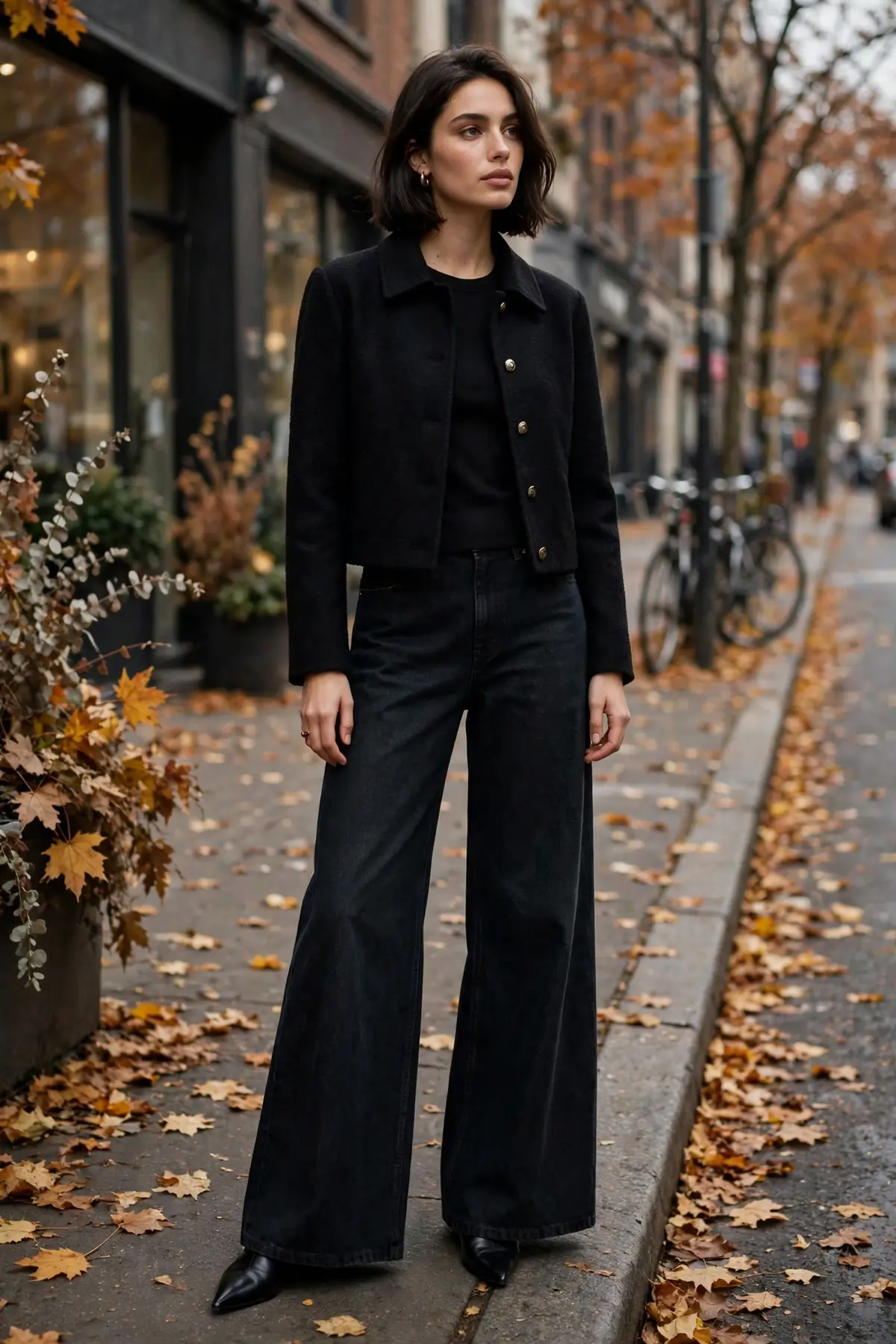
A nearly floor-skimming hem lengthens the line; a cropped or hip-length jacket keeps the silhouette balanced; a clean shoe prevents visual clutter.
Dark wide-leg jeans are the easiest hard-working item in fall dressing — and the easiest to get wrong. Get them right and you look long, calm and quietly expensive. Get them wrong and you look like you are wearing someone else's trousers in a puddle. The difference is not luck, and it is not body type. It is three rules, applied in order: the hem, the shoe, and the jacket. A nearly floor-skimming hem lengthens the line; a cropped or hip-length jacket keeps the silhouette balanced; a clean shoe prevents visual clutter. Learn those three, and dark wide-leg jeans become the pair you reach for on every day that matters.
First, why dark? Because dark denim is doing two jobs at once. It behaves like a trouser — it reads as polished, it goes with tailoring, it works at work — while keeping all the comfort and durability of jeans. Light denim is lovely, but it is casual by nature; it announces weekend. Dark denim, especially a deep indigo or near-black wash with no fading, announces intention. It is the wash that lets jeans sit next to a blazer without looking like a mistake, and it is the wash that photographs well, wears well, and hides a multitude of sins between washes.
Rule one: the hem
The hem is everything. For wide-leg jeans, the ideal hem nearly skims the floor when you are wearing your usual shoe — close enough to lengthen the leg, not so long that you are walking on denim. Too short, and wide legs turn stumpy: the leg looks cut off at the ankle and the whole outfit loses its line. Too long, and you are tripping, fraying and collecting street water, which is not a look, it is a laundry problem. The sweet spot is about a centimeter above the ground at the back, with the front just kissing the top of the shoe.
This means you cannot buy wide-leg jeans and hope. You have to try them with the shoe you will actually wear most, and you have to be willing to get them hemmed. A ten-minute tailor visit is the difference between jeans that look borrowed and jeans that look made for you, and it costs less than most lunches. If you wear multiple heel heights, hem for the middle one, or buy two pairs — one for flats, one for heels — rather than one pair that works with neither. Wide legs are unforgiving about hems in a way skinny jeans never were, because there is simply more fabric to get wrong.
Rule two: the shoe
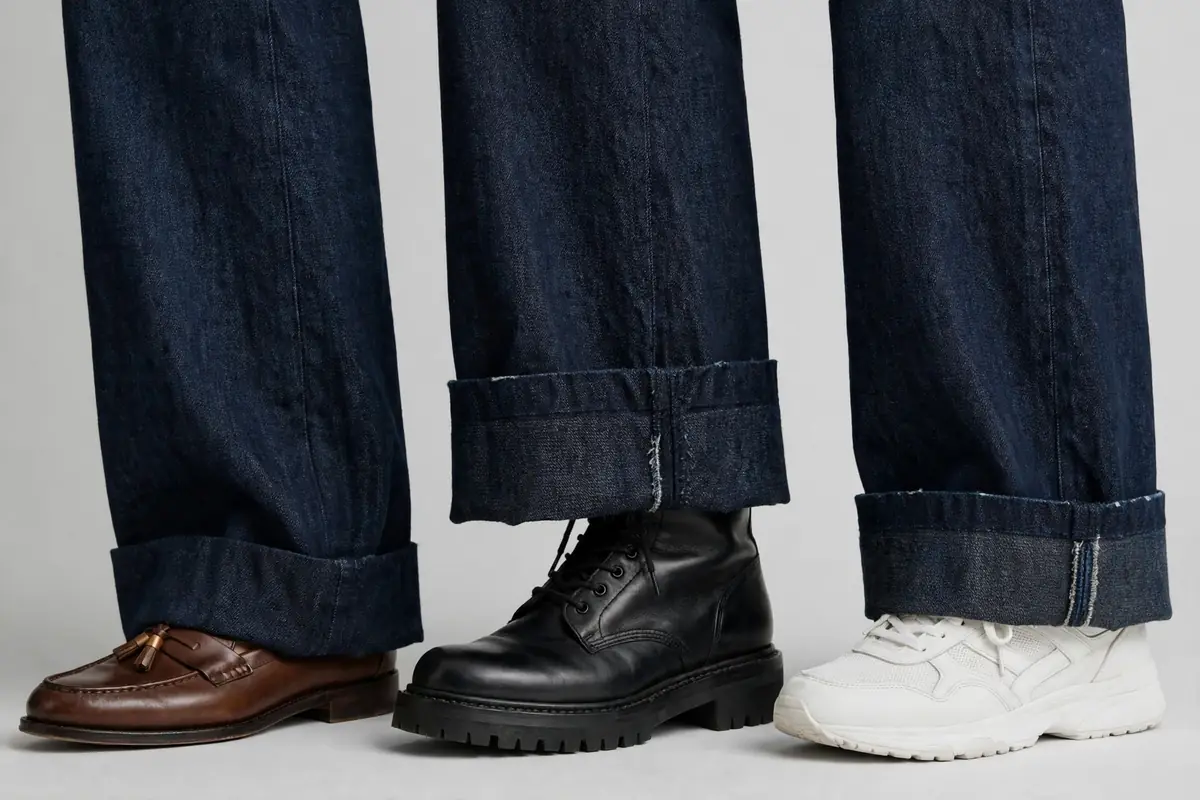
A clean shoe prevents visual clutter, and with wide legs, clutter is the enemy. The hem covers most of the shoe, so what peeks out matters disproportionately. A pointed toe — boot, loafer or flat — extends the line and keeps the outfit sharp. A chunky sneaker can work, but only if it is clean and low-profile; a battered, bulky trainer under wide dark denim drags the whole outfit into weekend territory. And a strappy, fussy shoe under a wide hem is wasted effort — nobody can see the straps, and the bulk at the ankle just adds noise.
For most fall days, the winning shoes are three: a pointed ankle boot, a clean loafer, or a low-profile white lace-up sneaker when the outfit is more casual. The boot is the workhorse — it adds height, it handles weather, it disappears neatly under the hem. The loafer is the polished option for office days. The sneaker is the off-duty version, and it works precisely because it is clean and simple, not because it is trying to be a statement. Whatever you choose, keep it in good repair. Scuffed shoes under perfect jeans are like a typo in a beautiful letter — small, but all you can see.
Rule three: the jacket
A cropped or hip-length jacket keeps the silhouette balanced, because wide legs already bring volume to the bottom half. A long coat over wide jeans is not forbidden — it is gorgeous in winter — but it needs care: the coat should be open, or the waist should be defined, or the whole outfit risks becoming one long rectangle with no shape at all. For everyday fall dressing, the safer, sharper choice is a jacket that ends at the hip or just above it, so the eye can register where the top ends and the long leg begins.
This is also where soft tailoring earns its place: an unstructured blazer at hip length over dark wide-leg jeans is one of the best work outfits of the season, because the blazer adds polish without adding bulk, and the jeans add ease without losing the line. A cropped knit, a tucked blouse, or a fitted tee all work on the same principle — definition on top, volume below. If your top is also oversized and long, tuck it, half-tuck it, or belt it. Two volumes with no definition is not relaxed; it is shapeless, and shapeless is the one thing wide legs should never be.
The top-half formulas that always work
Beyond the jacket rule, four top formulas never fail with dark wide legs. One: a fitted knit, tucked or half-tucked, with a coat over the top. Two: a crisp shirt, tucked in, sleeves pushed up evenly, with loafers. Three: a cropped sweater that ends at the waistband, so the leg line starts exactly where the top ends. Four: a blazer over a simple tee, the tee tucked, the blazer open. Notice what they share: the waist is visible or implied, the top is not competing with the trouser for volume, and the whole outfit has one clear focal point — the long, dark leg.
What to avoid on top: tunics that end mid-thigh over wide legs, which shorten the leg visually and add bulk exactly where you do not want it; very long, boxy coats worn closed, which hide the waist entirely; and busy prints on both halves at once. Wide legs are already a statement of proportion. Let them be the statement, and keep the top quiet, fitted, or both. The outfit will look more expensive for it, because restraint reads as confidence and clutter reads as indecision.
Fit details worth checking in the shop
Before the hem, check the waist and the rise. Wide-leg jeans need to sit at your natural waist — or at least stay put there — because a waistband that slides down will drag the whole proportion with it. A higher rise lengthens the leg further and keeps the top tucked neatly; a low rise with wide legs is a difficult combination that rarely flatters anyone, because it shortens the torso visually while widening the bottom half. Sit down in the shop. If the waistband gaps at the back when you sit, try another cut. That gap will not fix itself, and a belt is a bandage, not a solution.
Check the fabric, too. Rigid denim holds the wide shape beautifully but needs breaking in; stretch denim is comfortable immediately but can bag at the knee by evening if the stretch content is high. The sweet spot for most people is a low-stretch, mid-weight denim — enough give to sit comfortably, enough structure to keep the leg clean all day. And check the wash in daylight: “dark” under shop lights can be surprisingly faded at home. The pair you want looks almost black indoors and deep indigo outdoors, with no whiskering, no fading at the thigh, and no distressing. Distressing and wide legs fight each other; one is polish, the other is casual, and the outfit ends up unsure what it is.
Styling dark wide legs for different days
For work: dark wide legs, a tucked blouse or fitted knit, a hip-length blazer, pointed boots or loafers, a structured bag. For weekends: the same jeans, a chunky knit half-tucked, white sneakers, a crossbody bag. For evenings: the same jeans, a satin camisole or a velvet top, pointed heels, one good piece of jewelry. Notice that the jeans never change — the top, the shoe and the detail do all the work. That is the real value of a perfect pair: one purchase, dozens of outfits, and a morning routine that gets shorter instead of longer.
For colder days, the wide leg is actually an advantage: it fits over boots without bunching, it layers over tights without showing lines, and it looks intentional with a long coat when the coat is open and the waist is defined. Just keep the coat rule in mind — open, or belted, or with a shorter jacket underneath that defines the waist when the coat comes off indoors. Nobody sees your outfit under a closed coat anyway; the outfit that matters is the one you are wearing when the coat comes off, in the office, at lunch, at the table.
Care and the long game
Dark denim fades, and fading is the enemy of the polished wide-leg look. Wash cold, inside out, as rarely as you can get away with — spot-clean between washes, air them out, and skip the dryer, which is brutal on both color and shape. When the hem starts to fray from pavement contact, get it repaired before it becomes a feature; a frayed hem on wide legs reads as neglect, not style, unless you have deliberately chosen a raw hem and you are maintaining it on purpose.
Finally, run the 30-wear test before you buy a second pair: can you picture thirty wears, with tops and shoes you already own, in your real life? If the answer is yes — and for a well-fitting dark wide-leg pair, it usually is — then it is one of the best purchases of the season. Three rules, one great pair, and a silhouette that makes everything else in your closet work harder. Hem, shoe, jacket. In that order, every time. Get those right, and dark wide-leg jeans stop being a trend you are trying and start being the foundation you build fall on.
Part of the TrendThread hubs: Fall 2026 hub · Capsule & Formulas hub