TrendThread Journal
Three soft-tailoring outfits for hybrid work
Try a knit tee and fluid trousers, a dark-denim column under a blazer, or a midi skirt with an unstructured jacket and low-profile shoe.
Hybrid work broke the old work wardrobe, and honestly, good riddance. The stiff suit that only worked in a boardroom, the blouse that needed dry-cleaning after one wear, the shoes that punished you by lunch — none of them survived contact with a life split between home, office and everywhere in between. What replaced them is softer, smarter and much more wearable: soft tailoring. Try a knit tee and fluid trousers, a dark-denim column under a blazer, or a midi skirt with an unstructured jacket and low-profile shoe. Three outfits, one idea — structure without stiffness — and a workweek that finally feels like it was designed for a human.
Soft tailoring is not “casual Friday” and it is not loungewear with a blazer thrown over it. It is tailoring with the scaffolding removed: no heavy shoulder pads, no rigid canvas, no lining that crackles when you move. An unstructured blazer drapes like a cardigan and looks like a blazer. Fluid trousers hold a crease without holding you hostage. A knit tee replaces the button-down as the layer under everything, because it never gaps, never wrinkles into origami, and never makes you feel like you are wearing someone else's clothes. The result looks polished on a video call and feels fine on a train, a school run, or a long lunch.
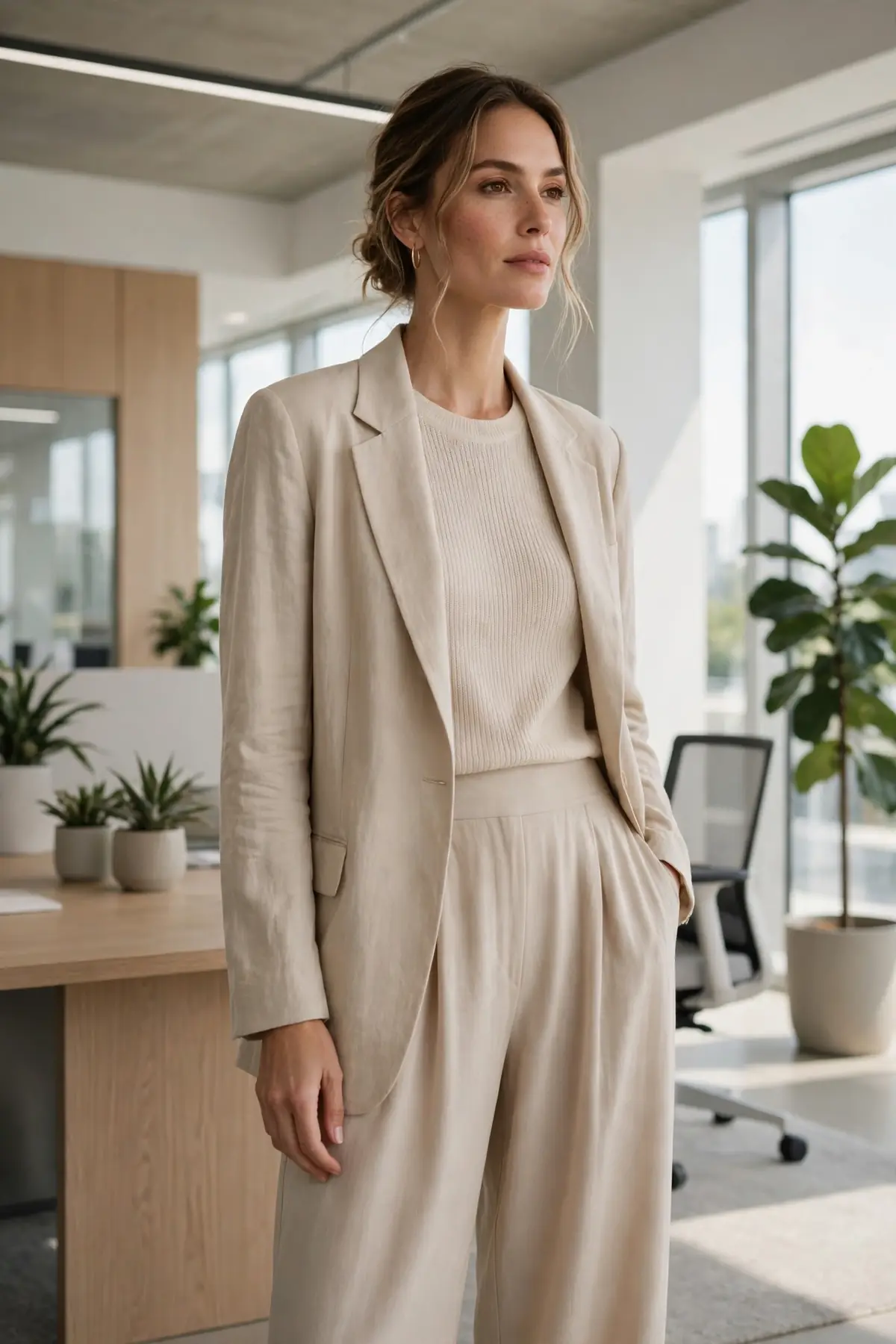
Outfit one: knit tee, fluid trousers, soft blazer
Start here, because this is the outfit that fixes the most mornings. A fine knit tee — black, navy or cream — tucked into fluid, wide-ish trousers, with an unstructured blazer over the top and a low-profile shoe below. The tee keeps it soft, the trousers keep it long, the blazer keeps it work. It works in a meeting, it works at a desk, and crucially, it works when the meeting turns out to be a walking meeting and you are suddenly doing three miles in what you wore to sit down.
The details make it. Steam the lapel, push or roll the sleeves evenly, and keep the base layer smooth — relaxed tailoring looks strongest when the details remain deliberate. That is the whole secret of soft tailoring: the softer the structure, the more the finish matters. A wrinkled tee under a beautiful blazer reads sloppy; a smooth tee under the same blazer reads intentional. It takes ninety seconds with a steamer and it changes the entire outfit, which is a very good return on ninety seconds.
Outfit two: the dark-denim column under a blazer
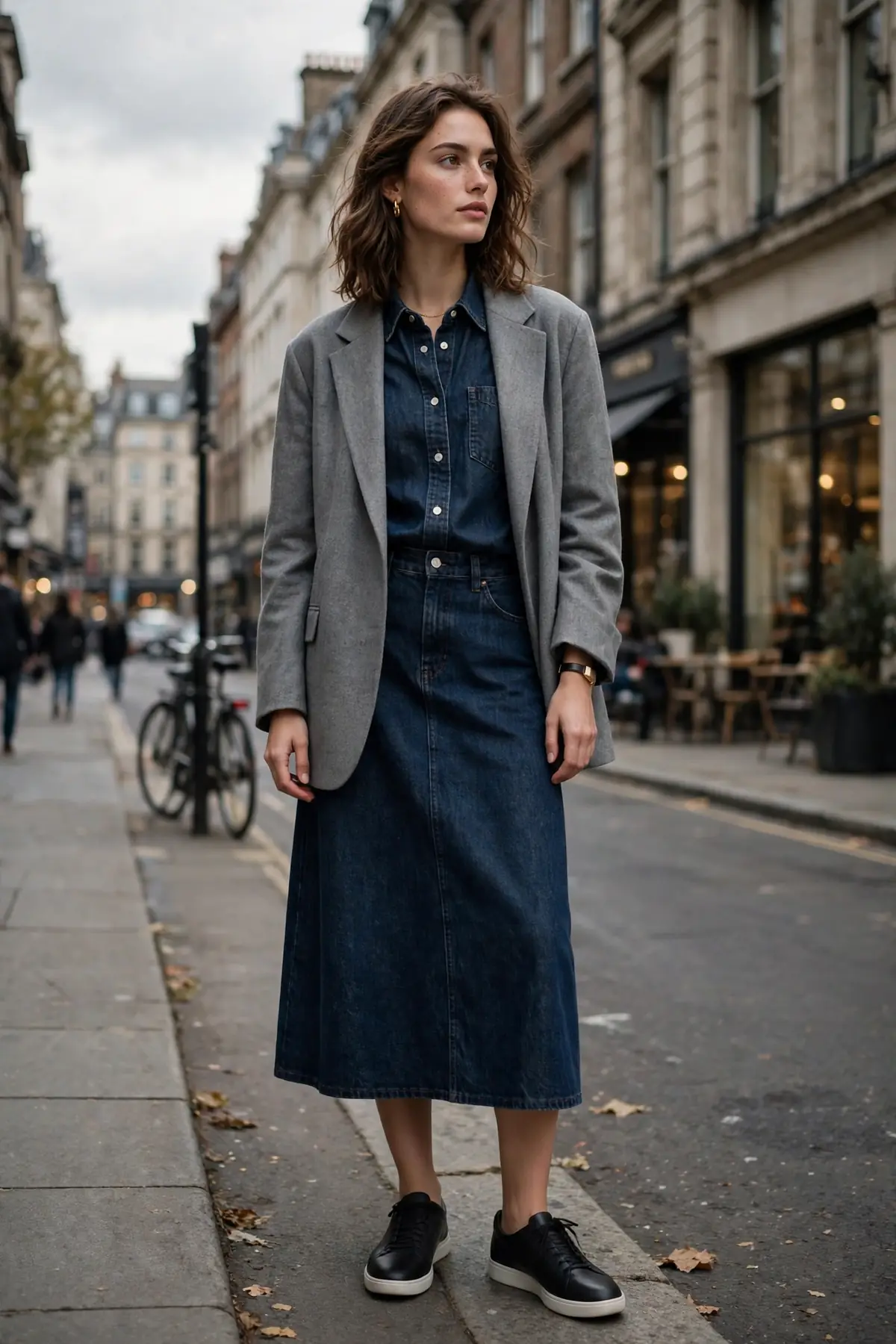
Yes, denim at work — but a specific denim. Dark, clean, no fading, no rips, no whiskering, worn as a column: dark jeans, a dark top, a blazer over the top, one long line from shoulder to shoe. The column is what makes denim read as workwear instead of weekend wear, and it is why dark wide-leg jeans have become an office staple: the hem, the shoe and the jacket length all work together to keep the silhouette long and calm.
Keep the shoe clean and low — a loafer, a white lace-up, a simple boot — and keep the blazer hip-length or slightly cropped so it does not chop the column in half. The bag should be structured enough to hold a laptop without sagging, because a slouchy tote undoes the whole column effect in one glance. This is the outfit for office days when you want to look like you mean business but also like you could leave at five and go straight to dinner without changing. That is not a compromise; that is the whole point of hybrid dressing.
Outfit three: midi skirt, unstructured jacket, low-profile shoe
The third outfit is the one people forget, and it is often the best one. A midi skirt — pleated, A-line, or a simple straight cut — with an unstructured jacket and a low-profile shoe is polished without being predictable, and it solves the eternal skirt problem: how to look professional without feeling like you are in a costume. The midi length is doing quiet work here. It shows just enough shoe to keep the outfit light, it moves well when you walk, and it pairs with boots in winter and loafers in spring without changing anything else.
Balance the proportions: if the skirt has volume, keep the jacket closer to the body; if the skirt is slim, let the jacket be a little roomier. A knit top tucked in keeps the waist defined, and a single detail — a brooch, a slim belt, a good bag — finishes it. This is also the outfit where the one-detail method shines: one vintage-minded accessory on an otherwise simple base reads as styled, not decorated, and it is the fastest way to make a repeat outfit feel new on its third wear of the month.
How to shop soft tailoring without getting fooled
Not everything labelled “soft” or “unstructured” actually is. Do the sit test before you buy: sit down, cross your legs, reach overhead. If the jacket pulls across the back, if the trousers dig at the waist, if the shoulders sit anywhere but on your shoulders, it is not soft tailoring — it is stiff tailoring with softer marketing. Real soft tailoring should feel like the nicest cardigan you own, just with lapels. Check the inside, too: a truly unstructured jacket has minimal lining and no heavy padding, and it will feel light in your hands before you even put it on.
Fabric is the other tell. Look for wool with stretch, or wool blended with a little elastane, or high-quality crepe that resists wrinkles. Pure linen wrinkles beautifully on holiday and terribly in a meeting; pure stiff cotton holds a shape you may not want to hold all day. The best hybrid fabrics are the boring ones: mid-weight wool, wool-crepe, a good ponte for trousers. They pack, they recover, they survive a commute. And when in doubt, buy the darker color — navy, charcoal, chocolate — because dark soft tailoring reads more formal than light soft tailoring, which gives you more days per piece.
Building a five-day hybrid week from three outfits
Here is where the three outfits earn their keep: they are not three outfits, they are a system. Monday: knit tee, fluid trousers, blazer. Tuesday, working from home: same trousers, same tee, no blazer, a cardigan instead — nobody on video will know, and you will feel like you got dressed properly anyway. Wednesday, office day: the denim column with the blazer. Thursday: midi skirt, unstructured jacket, loafers. Friday: denim column again, different top, sneakers instead of loafers, blazer optional. Five days, three formulas, no morning panic.
The capsule logic behind this is the same one in the 12-piece capsule: a small number of pieces that combine in many directions, varied by surface and proportion so repeats do not look like repeats. Change the shoe, change the detail, change the layer — the base stays the same and the outfit changes. That is how people who always look put-together actually do it. They are not buying more clothes. They are buying fewer, better-connected ones, and wearing them with more intention.
The finishing rules that make soft look sharp
Control the finish. Steam the lapel, push or roll the sleeves evenly, and keep the base layer smooth. Relaxed tailoring looks strongest when the details remain deliberate — and that applies to everything else, too. Shoes polished, not just clean. Bag structured, not sagging. Jewelry minimal: one or two pieces, not a collection. Hair and makeup, if you wear them, simple enough that they do not compete with the outfit. Soft tailoring is quiet by design, and quiet outfits are ruined by noise, not by simplicity.
Also: know when soft is not enough. A formal client meeting, a court appearance, a job interview at a traditional firm — those still call for real structure, and pretending otherwise does not make you modern, it makes you underdressed. Soft tailoring is for the 90 percent of work life that is now hybrid, not for the 10 percent that is still formal. Keep one structured blazer for those days, wear it proudly, and return to soft the next morning with relief. The best work wardrobe is not the one that follows one rule; it is the one that knows which rule each day needs.
Care, cost, and the long game
Soft tailoring earns its price in wears per week, not in compliments per wear. A blazer you reach for three times a week is cheap at twice the price of one you wear twice a year, and that math is worth doing before you flinch at a price tag. Before buying, run the 30-wear test: can you picture thirty realistic wears, across seasons and settings, with things you already own? A navy unstructured blazer passes easily. A patterned statement blazer usually does not, and that is fine — statement pieces are for later, after the workhorses are in place.
Care for it properly and it will last. Steam instead of ironing where you can, dry-clean sparingly rather than after every wear, and hang blazers on proper wide hangers so the shoulders keep their shape. Fluid trousers should be hung, not folded, if you have the space; folded creases in soft wool are stubborn. And at the end of each week, do a two-minute reset: steam the blazer, wipe the shoes, put the knit back in shape. Hybrid work asks a lot of a small wardrobe. A little maintenance is how a small wardrobe keeps saying yes, week after week, without ever looking tired. That is soft tailoring at its best: not a trend, but a truce between looking good and feeling good — finally, in the same outfit.
Part of the TrendThread hubs: Fall 2026 hub · Capsule & Formulas hub